
Explore the world · Ingredient history · Reference page
Vegetables: from wild cabbage to the Brussels chicon
Cabbage, kale, broccoli and Brussels sprouts are one Mediterranean species. Onions and garlic come from Central Asia, while squash, tomatoes and chillies were domesticated in the Americas and later carried to Europe. Brussels gave the world the blanched chicon in the nineteenth century. This page also looks at how scientists have tried to map where crops began.
Mapping where crops began
The question of where vegetables come from is older than genetics. The Swiss botanist Alphonse de Candolle worked on the geographical origin of cultivated plants from 1836, asking where each crop began, how it spread and when it was domesticated. His work fed into Darwin's thinking about domestication.
The Russian botanist Nikolai Vavilov turned the question into a world map. His paper Centers of origin of cultivated plants appeared in 1926. Vavilov looked for a crop's homeland where its varieties were most diverse, using botany, geography and the history of words. He also kept changing his mind: publications up to 1940 show him revising ideas he had first set out in 1919. Trofim Lysenko and his allies campaigned against Vavilov's school, and Vavilov died in a Soviet prison in Saratov in 1943. His collections, and his idea that crop diversity must be conserved, underlie today's genebanks.
Vavilov's centres are best read as a historical idea, not a finished answer. A 2014 study of chilli peppers points out that origin studies traditionally relied on finding areas of high diversity. Researchers now add plant microfossils, ancient DNA, radiocarbon dating and linguistics, and these lines of evidence do not always point to the same place.
One species, many vegetables: the cabbage family
Cabbage, kale, broccoli, cauliflower, kohlrabi and Brussels sprouts all belong to a single species, Brassica oleracea, which makes it a textbook case of what human selection can do. Which wild plant they came from has long been argued. Older authors proposed different wild ancestors for different crops.
In 2021 Mabry and colleagues sequenced 224 samples covering 14 crop types and nine candidate wild relatives. Their closest match was Brassica cretica, a wild plant found only around the Aegean, which supports cultivation beginning in the eastern Mediterranean. They also found several feral lineages: cultivated plants that had escaped and reverted to a wild-looking state. A cabbage growing wild is therefore not necessarily the ancestor.
Written sources fit the eastern Mediterranean origin. The earliest literary references are Greek and date from 2,500 to 2,000 years ago. Theophrastus describes three kinds, curly-leaved, smooth-leaved and a bitter wild type, and Pliny, writing about two centuries later, names at least ten more. The authors suggest the crop spread west with seafaring trade from the Late Bronze Age, 3,300 to 3,000 years ago.
Onions and garlic from Central Asia
The onion family, Allium, has its greatest diversity in a belt from the Mediterranean through Central Asia to western China. The wild relatives of the onion grow mainly in the Irano-Turanian region, the dry mountains and steppes from Iran to Central Asia. Molecular studies identify Allium vavilovii, named after Vavilov, as the onion's closest relative.
Garlic took a different path. Most cultivated garlic is sterile and has been grown for thousands of years from cloves, not seed, which fixed useful forms but stopped new crosses. A 2026 review places garlic's origin in Central Asia and shows it spreading from the Irano-Turanian region roughly 10,000 years ago, then reaching the Mediterranean, India and China around 3,000 years ago. Its closest wild form, A. longicuspis, looks almost identical to garlic, and whether it is a true wild ancestor or a feral garlic is still debated. East Asia domesticated its own alliums: the Welsh onion from A. altaicum, and Chinese chives in northern China more than 3,000 years ago.
Squash, tomatoes and chillies from the Americas
Many vegetables now basic to European cooking are American. Squashes, pumpkins and gourds of the genus Cucurbita were domesticated several times in the Americas, beginning about 10,000 years ago in Mexico. Cucurbita pepo, which includes courgettes, pumpkins and summer and winter squash, was domesticated in the Valley of Oaxaca and is unknown in the wild today. Kistler and colleagues propose that wild squashes, bitter to humans, depended on mastodons and other large animals to spread their seeds. When those animals died out, the plants survived mainly in human fields.
The tomato's history has two stages. A wild species grows in Ecuador and Peru. A partly domesticated cherry-type tomato arose in South America and spread north. The fully cultivated tomato took shape in Mexico, where traits that had faded on the journey were selected again. Part of this Mexican crop was later carried to Europe and spread around the world.
Chilli peppers (Capsicum annuum) were domesticated in Mexico too. Kraft and colleagues combined genetics, archaeology, climate models and historical linguistics and favoured central-east Mexico. The oldest chilli remains come from dry caves in Puebla (the Tehuacán Valley) and Tamaulipas, and the oldest reconstructed word for chilli belongs to Proto-Otomanguean, spoken about 6,500 years ago. Tomatoes and chillies are now among the five vegetables with the largest harvested area in the world.
Witloof: a Brussels invention
Chicory (Cichorium intybus) was grown for centuries for its root and leaves. The chicon, or witloof, is something else: a tight, pale head grown in the dark from a forced root. According to the dossier that put the culture of chicory on the Brussels-Capital Region's intangible heritage inventory on 15 March 2021, it was developed in north-east Brussels in the middle of the nineteenth century.
How it happened is told in two ways. One version is an "accidental" discovery by a farmer in Schaerbeek or Evere. The dossier calls a second version "perhaps the most plausible": around 1840, François Bréziers, head gardener of the Botanical Garden at the Porte de Schaerbeek in Saint-Josse-ten-Noode, experimented with barbe de capucin, a chicory grown for blanched leaves. He crossed it with a thick-rooted Magdeburg-type chicory and forced the roots under a cover of soil and manure. The result was a closed head instead of loose leaves. The concert hall in the cellars of today's Botanique remembers him with its name, Witloof Bar.
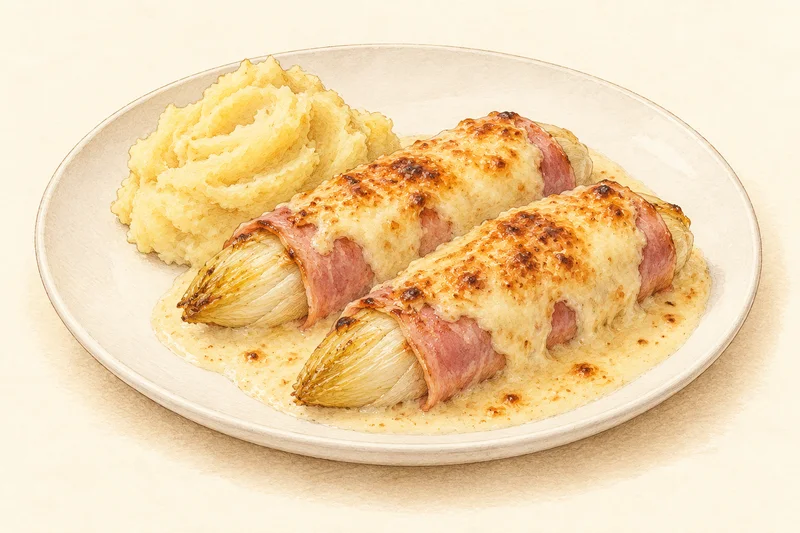
The vegetable was a luxury at first. Growers moved out to Schaerbeek, Evere and Haren as the city grew, and later to the "chicon triangle" of Brussels, Mechelen and Leuven. Exports began in 1872, first to Paris and Amsterdam and then by steamship to the Americas. Only from 1930 did chicory become an everyday food. A 2018-19 thesis at the Université libre de Bruxelles dates chicons au gratin to the 1930s, as a mix of two older recipes: chicory cooked with bacon and chicory baked with Gruyère.
Market gardens and modern breeding
Witloof grew out of market-garden know-how. The Brussels dossier notes that in the eighteenth and nineteenth centuries market gardeners already grew some plants without light, including endive, lettuce and barbe de capucin (a wild chicory), to get leaves that were tenderer and less bitter. Production in Brussels shrank as the city built over its fields. About a hundred people still force chicory there. A few do it in open ground, but most use growing or forcing trays.
Vegetables are now a very large crop. In 2024 the world produced 1.2 billion tonnes, and fruit and vegetables together covered 128 million hectares. Dry onions and shallots, tomatoes, okra, green chillies and peppers, and green peas took a third of all vegetable land. Tomato output rose by 20 % between 2010 and 2024.
Breeding for yield and shipping has had costs. A 2017 study of 398 tomato varieties found that modern commercial tomatoes contain much lower amounts of many flavour chemicals than heirloom varieties. The authors mapped the genes involved so that flavour can be bred back. Researchers working on the tomato and the cabbage both stress that wild relatives, and older or semi-domesticated forms, hold useful genes for future breeding.
How it connects
Recipe
- related Chicory with ham and cheese sauce
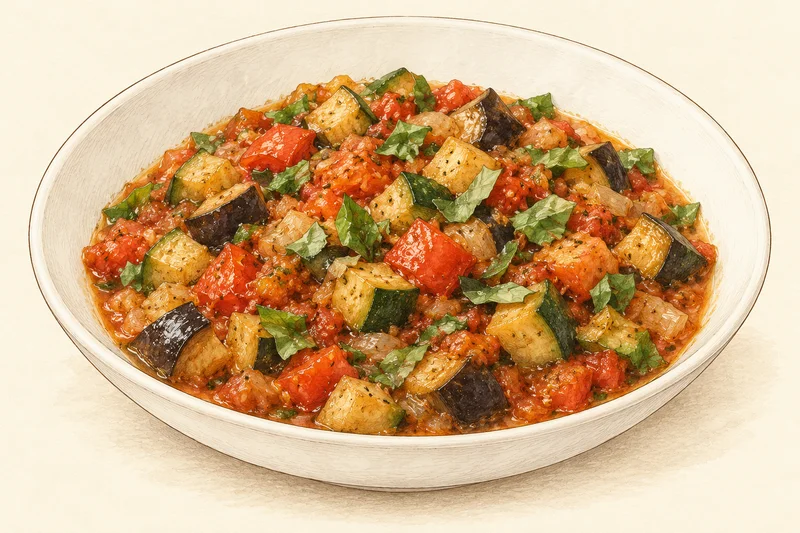
- related Ratatouille
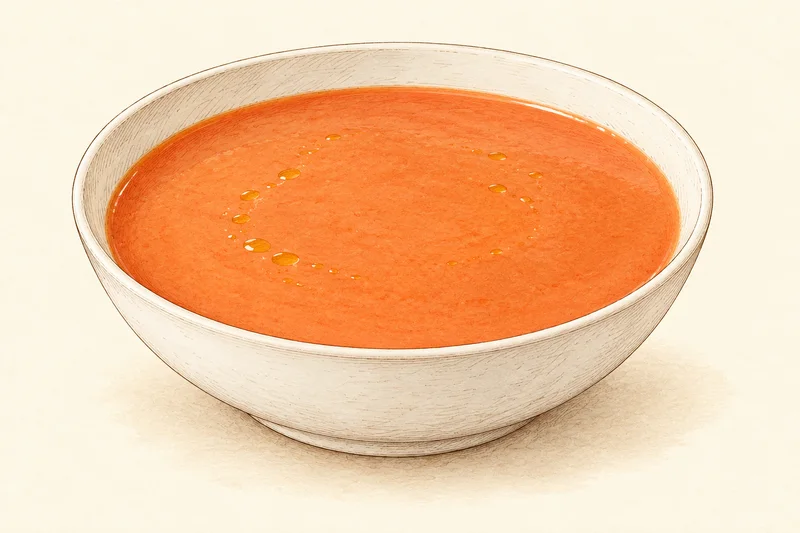
- related Gazpacho
- related Asparagus Flemish style
Place
- related Brussels In preparation
Continue exploring
- CountryGreece6 entries in the atlas so far
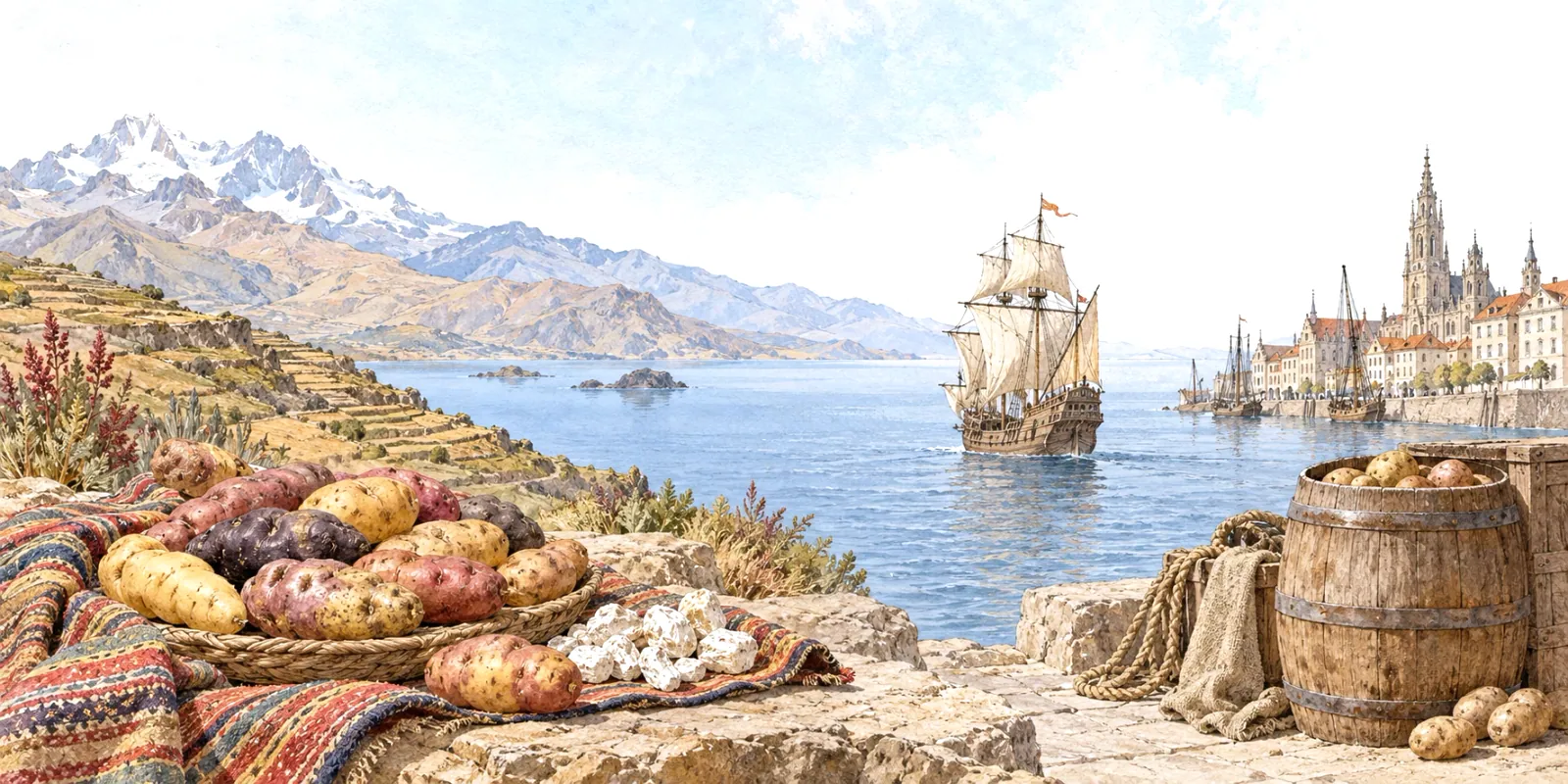 StoryFrom the Andes to EuropeLake Titicaca, Peru
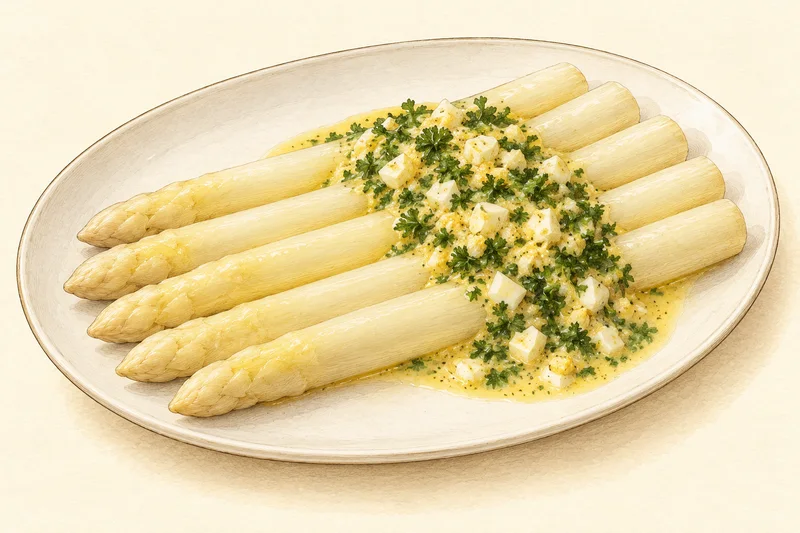 RecipeAsparagus Flemish styleBelgium
- RecipeChicory with ham and cheese sauceBelgium
- RecipeGazpachoAndalusia, Spain
- RecipeRatatouilleProvence, France
- StoryFruit: from the apple forests of the Tian Shan to the banana boatKazakhstan
- StoryLegumes: lentils, beans and the plants that feed the soilTurkey
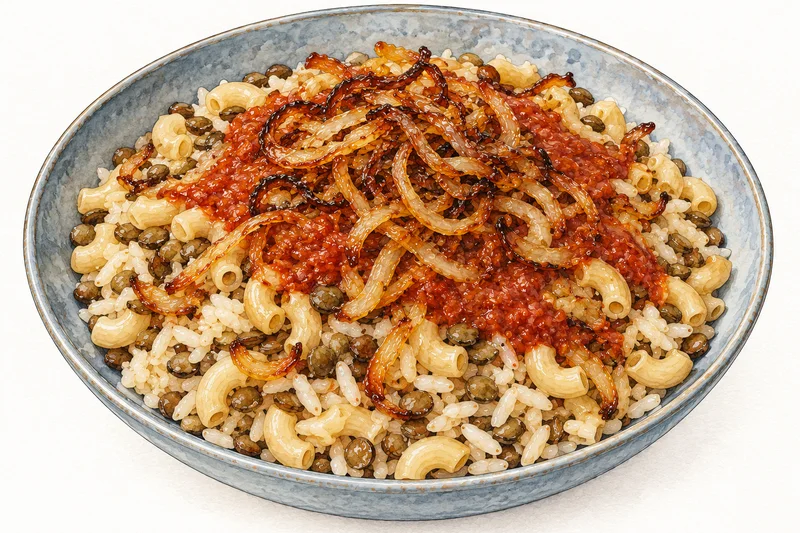 RecipeKushariEgypt
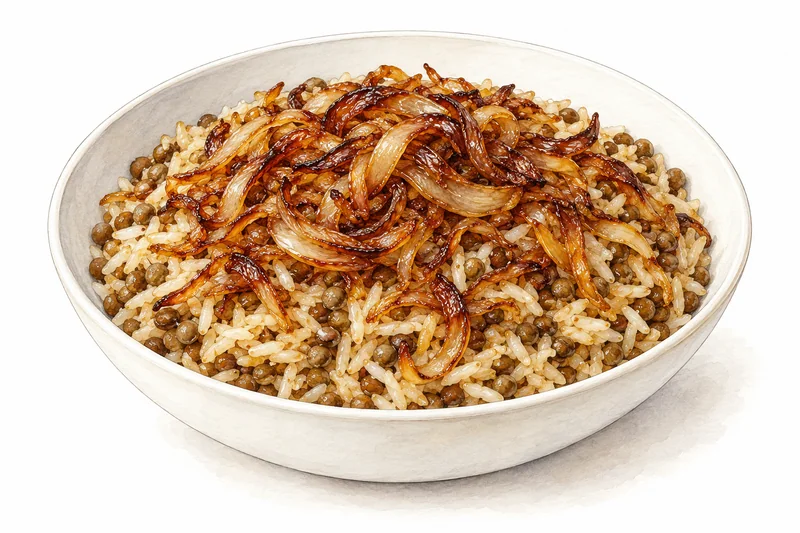 RecipeMujaddara (rice and lentils)Lebanon