- Disputed
The Raqefet Cave mortars (c. 13,700-11,700 cal BP) are claimed as the earliest evidence of brewing; other archaeologists read them as evidence of grinding grain for bread.
→ A history of beer - Prevailing view
The Hymn to Ninkasi is not a usable recipe: its three modern translations differ on the key brewing terms.
→ A history of beer - Documented
The word 'Reinheitsgebot' was coined in the early twentieth century; it was first used in the Reichstag in 1909.
→ A history of beer - Documented
The 1516 Bavarian ordinance allowed only barley, hops and water in beer.
→ Barley - Documented
The first dated document linking hops to brewing is the statutes of Abbot Adalhard of Corbie, 822; they do not explain how the hops were used.
→ Hops - Documented
Finished malt holds 3-6 % moisture and can be stored for months.
→ Malting - Documented
Beer culture in Belgium was inscribed on UNESCO's Representative List of the Intangible Cultural Heritage of Humanity in 2016 (11.COM).
→ Belgium - Documented
Lambic hops are aged for several years before use and are valued for preservation rather than bitterness.
→ Lambic - Documented
A TSG protects a traditional recipe and method, not a place: Oude Geuze is defined by how it is made.
→ Gueuze (Oude Geuze) - Disputed
Some secondary accounts date the International Trappist Association to 1997; the association's own FAQ gives 1998.
→ Trappist beer (Authentic Trappist Product) - Documented
Josef Groll brewed the first batch of Plzeň pale lager on 5 October 1842; it was first presented on 11 November 1842.
→ Pilsner (Czech pale lager) - Local tradition
The idea that Groll created pale lager by accident with the 'wrong malt' is a legend.
→ Pilsner (Czech pale lager) - Disputed
Ralph Harwood invented porter in 1722.
→ Porter - Disputed
George Hodgson invented India pale ale to survive the voyage to India.
→ India pale ale (IPA) - Documented
Samuel Allsopp's first pale ale consignments for India were shipped in 1823.
→ India pale ale (IPA) - Disputed
The Hymn to Ninkasi is the oldest beer recipe.
→ The Hymn to Ninkasi - Documented
The 1516 ordinance did not mention yeast; Bamberg's ordinance of 1489 already permitted it.
→ The Bavarian beer ordinance of 1516 ('Reinheitsgebot') - Documented
Jacob van Maerlant's *Der naturen bloeme* (c. 1266) recommends juniper boiled in rainwater or wine as a remedy but describes no distilled spirit.
→ From juniper water to London gin - Disputed
Franciscus Sylvius (1614–1672) invented genever or gin. This attribution is unsupported and traces to an 1824 essay.
→ From juniper water to London gin - Documented
London spirit consumption fell from 8.5 million gallons in 1751 to 2.1 million by 1760.
→ From juniper water to London gin - Documented
Oude and jonge genever differ in moutwijn content, colour and sugar, not in age.
→ Genever - Disputed
Genever was invented by Franciscus Sylvius in Leiden around 1650.
→ Genever - Documented
London gin may not be coloured and may contain no more than 0.1 g of sweetening per litre.
→ London gin (London dry gin) - Documented
'London gin' is not a geographical indication; it can be made anywhere.
→ London gin (London dry gin) - Documented
Oude and jonge genever may be made only in the Netherlands and Belgium.
→ Netherlands - Local tradition
The Black Friars distillery building was once a friary.
→ Black Friars distillery (Plymouth) - Disputed
The 1751 Gin Act alone ended the Gin Craze.
→ Gin Act of 1751 - Documented
Gin must taste predominantly of juniper (Juniperus communis) under EU law.
→ Juniper - Documented
Vapour-infused gins contain more monoterpenes than steep-infused gins (Hodel et al. 2019, as summarised by Parr et al. 2024).
→ Vapour infusion - Documented
The Aubrac herd book was created in 1893; the breed society founded in 1979 (Union Aubrac) took it over.
→ Aubrac - Documented
The first artificial insemination in France was performed on a Normande cow in 1946.
→ Normande - Local tradition
The Fête des Bœufs Gras at Bazas has been held for more than nine centuries.
→ Bazadaise - Documented
Piemontese double muscling is caused by a missense mutation in the myostatin gene, reported in 1997.
→ Piemontese - Local tradition
Goths led by Aginulfo brought the ancestors of the Romagnola into Romagna in the fourth century.
→ Romagnola - Disputed
How the Podolica reached Italy is unresolved: the breed standard gives both an arrival with the Huns in 452 and an earlier introduction from Crete.
→ Podolica - Prevailing view
The Barrosã descends from a North African trunk of cattle that reached Iberia by migration.
→ Barrosã - Documented
The double-muscling of Belgian Blue cattle is caused by a natural loss-of-function mutation in the myostatin (MSTN) gene, identified in 1997.
→ Belgian Blue - Documented
There are four wagyu breeds: Japanese Black, Japanese Brown, Japanese Shorthorn and Japanese Polled.
→ Japanese Black (Wagyu) - Documented
The UNECE beef standard pairs the French name onglet with its 'thick skirt (hanging tender)', the lumbar portion of the diaphragm.
→ Onglet (hanger) - Documented
Interbev classes the hampe among the produits tripiers (offal products), and AHDB likewise codes diaphragm skirt steaks as offal.
→ Hampe (skirt) - Documented
The rond de gîte, the American eye of round and the UNECE eye round are all the M. semitendinosus.
→ Rond de gîte (eye of round) - Documented
Interbev: a true tournedos can only come from the filet; steaks cut like it from elsewhere must be sold as 'façon tournedos' with the name of the cut.
→ Filet mignon (French butchery) - Documented
The Iberian pig herd book was created by a Spanish ministerial order of 28 May 1987 and has always been kept by AECERIBER.
→ Iberian pig - Documented
Eleven Šumadija pigs (nine sows, two boars) arrived at Kisjenő in 1833 as a gift from Prince Miloš of Serbia to Archduke József.
→ Mangalica - Disputed
Sources disagree on the size of the 1833 gift; the 2003 review gives nine sows and two boars, while other accounts give a different number.
→ Mangalica - Documented
The white belt of the Cinta Senese must fully circle the trunk at the shoulders and include the forelegs; small black spots inside the belt are allowed.
→ Cinta Senese - Disputed
Sources disagree on when the Large Black breed society was founded: the RBST gives 1889, The Livestock Conservancy 1898.
→ Large Black - Documented
A Large Black raised for pork is usually slaughtered at about 80 kg live weight, giving a carcass of about 60 kg.
→ Large Black - Local tradition
The black spots are said to be bruises from falling apples.
→ Gloucestershire Old Spots - Documented
The Piétrain carries a fixed mutation of the ryanodine receptor (halothane locus) that causes porcine stress syndrome and PSE meat; a stress-negative line was created at the University of Liège.
→ Piétrain - Prevailing view
The name Herdwick is said to derive from an Old Norse word for a sheep farm.
→ Herdwick - Documented
Bresse poultry was mentioned in the municipal records of Bourg-en-Bresse in 1591.
→ Bresse - Disputed
Accounts of the breed's creation differ: the Rare Poultry Society credits a Mr de Winter, while a 2025 press account starts the story in the 1850s with birds from Antwerp Zoo.
→ Malines - Documented
The breed's English name was spelled in several ways (Rhone, Rohan, Roan) before settling on Rouen.
→ Rouen - Local tradition
Bologna's official tagliatella, deposited in 1972, is said to equal 1/12,270 of the height of the city's Asinelli tower when cooked.
→ Tagliatelle - Local tradition
A popular legend says tortellini were modelled on the navel of Venus; it is a story, not history.
→ Tortellini - Documented
Italy's traditional-products list names three Ligurian corzetti separately: those of the Val Polcevera, those of the Levante Ligure and the 'corsetti avvantaggiati'.
→ Corzetti della Val Polcevera - Local tradition
Stamped corzetti were made for noble tables bearing the family coat of arms.
→ Corzetti stampati - Local tradition
Two stories explain the name: that it derives from the *anolino* of Parma, or from a Monferrato cook called Angelotu (Angiolino). Neither is documented.
→ Agnolotti piemontesi - Documented
Pizzoccheri della Valtellina were entered in the EU register of protected geographical indications by Regulation (EU) 2016/1730 of 22 September 2016.
→ Pizzoccheri della Valtellina - Documented
Italy's list of traditional products records casoncelli of the Bergamo area and, separately, the casoncello of Barbariga and of Pontoglio, both in the province of Brescia.
→ Casoncelli - Local tradition
In Mantuan tradition the tortelli come before a stuffed capon, with sbrisolona cake to finish.
→ Tortelli di zucca mantovani - Documented
A Padua petition dated 26 January 1604 sought a five-year privilege for a bigoli press, as reported by AGI in 2026.
→ Bigoli - Local tradition
The 'nodo d'amore' legend was attached to the tortellino by local restaurateurs as a name; it is not a documented origin of the pasta.
→ Tortellini di Valeggio sul Mincio - Local tradition
A Carnic joke says one cjalzòn, rolling downhill, once blocked the bed of the Chiarsò stream.
→ Cjalzòns - Prevailing view
ERSA's atlas says plum gnocchi are of Bohemian origin and reached the region with the nobility and officials of the Austro-Hungarian administration.
→ Gnochi de susini - Documented
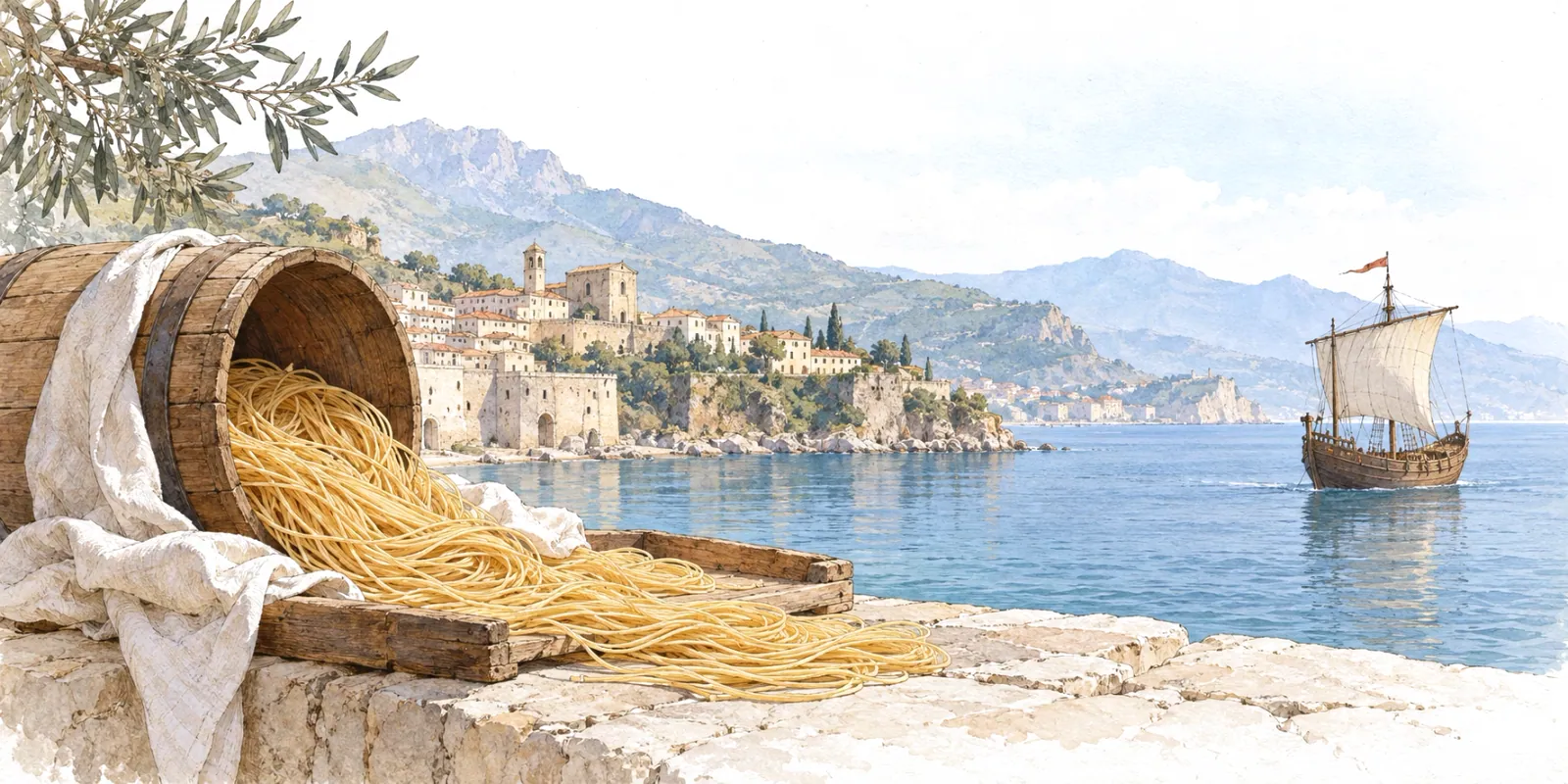
The story that Marco Polo brought pasta to Italy from China is a myth; dried pasta was documented in Sicily over a century before his return in 1295.
→ Spaghetti - Documented
Pasta di Gragnano has been protected as an EU geographical indication (PGI) since 2013.
→ Spaghetti - Local tradition
Snapping spaghetti before cooking is frowned on in Italy; it is a matter of custom and eating style, not of food safety or chemistry.
→ Spaghetti - Documented
Bintje was named after its breeder's favourite pupil, Bintje Jansma.
→ Bintje - Documented
Belgium's fry tradition is older than Bintje — fried potatoes were sold at fairs in the nineteenth century by vendors such as Jean Frédéric Krieger, "Monsieur Fritz", a Bavarian immigrant who learned the trade in Paris and set up as a fairground fry-seller in Belgium in 1844.
→ Bintje - Documented
HZPC's growing advice warns that Spunta sets few tubers, which easily grow too big.
→ Spunta - Documented
Agrico says the variety is named after the breeder's favourite restaurant, an Italian pizzeria called Fontana; the name Fontana was not accepted for registration, so one letter was changed.
→ Fontane - Documented
A bud mutant with blue skin, the Blauwe Eigenheimer, appeared around 1907. It ripens slightly earlier and was valued as a tasty blue potato in some Dutch cities.
→ Eigenheimer - Documented
The PDO allows the potato to be grown only once every three years on the same land, on about 450 ha around Opperdoes.
→ Opperdoezer Ronde - Disputed
The claim that fries were invented in the Meuse valley rests on a 1781 manuscript published by Jo Gérard in 1984; historians such as Pierre Leclercq reject it.
→ Belgian frites - Documented
In Escoffier's Guide culinaire (1903), 'à la bourguignonne' means cooked with red wine; for meat it brings the garnish of lardons, glazed small onions and mushrooms. Escoffier also gives eggs poached in a red-wine sauce without that garnish, chicken sautéed with the full garnish, and fish braised in red wine.
→ Bœuf bourguignon - Documented
In this recipe the beef marrow is melted in butter for 1 minute before the onion goes in, and the saffron is added only for the last 5 minutes of cooking.
→ Risotto alla milanese - Documented
The paella valenciana was declared a Bien de Interés Cultural Inmaterial by Decree 176/2021 of 29 October 2021, published in the BOE on 15 March 2022.
→ Paella valenciana - Local tradition
The decree places the origin of paella among the farmers of the Albufera of Valencia; this is the regional government's account, not a documented first recipe.
→ Paella valenciana - Documented
In this method the rice is cooked to about 70% before layering, and the sealed pot cooks 5 minutes on high heat and 30–40 minutes on very low heat.
→ Hyderabadi chicken dum biryani - Documented
In this recipe the tomato and pepper paste is fried for about 15 minutes in total, until the oil separates, before the rice is added.
→ Jollof rice with chicken - Documented
In Adam Liaw's method the rice is covered with liquid by 2 cm, boiled until the liquid reaches the top of the rice, then steamed covered for 12 minutes and rested 5.
→ Nasi lemak - Local tradition
Bibimbap began as farmers' food made from leftovers.
→ Jeonju bibimbap - Local tradition
The name kensan-yaki is said to come from Uesugi Kenshin grilling rice balls on his sword for his soldiers.
→ Kensan-yaki (miso-grilled rice balls) - Documented
In this version the lentils are simmered about 10 minutes before the rice is added for a further 10 minutes.
→ Mujaddara (rice and lentils) - Documented
In this recipe the strained tomato purée and stock together make 4 cups of liquid for 2 cups of rice.
→ Arroz rojo (Mexican red rice) - Documented
Anissa Helou's tabbouleh uses 30 g fine bulgur to 400 g parsley and 600 g tomatoes.
→ Tabbouleh - Documented
Polenta was traditionally cooked in a copper pot called a paiolo over an open fire.
→ Soft polenta - Documented
UNESCO inscribed couscous knowledge and practices in 2020 on the nomination of Algeria, Mauritania, Morocco and Tunisia.
→ Steamed couscous - Documented
Cloake fries a garlic clove in the oil and discards it before cooking the pancetta, so only its aroma remains.
→ Spaghetti alla carbonara - Local tradition
The link between cacio e pepe and Lazio's shepherds is a local tradition.
→ Cacio e pepe - Documented
Turismo Roma's recipe for four uses 400 g of spaghetti and 100 g of grated Pecorino Romano DOP.
→ Cacio e pepe - Documented
The Accademia Italiana della Cucina deposited its updated ragù alla bolognese recipe at the Bologna Chamber of Commerce on 20 April 2023.
→ Ragù alla bolognese - Documented
The 2023 deposit excludes garlic, rosemary, parsley, veal, smoked pancetta and flour.
→ Ragù alla bolognese - Documented
Cooking potatoes and green beans with the pasta is described by the consortium as an old Genoese custom, not part of the official recipe.
→ Trofie al pesto genovese - Documented
In this recipe the orecchiette and the cime di rapa are boiled together in the same pot.
→ Orecchiette con cime di rapa - Prevailing view
David Thompson writes that pad thai's origins are firmly rooted in Chinese cooking.
→ Pad thai - Documented
In Luke Nguyen's method 6 litres of water simmer for 3 hours and reduce to about half.
→ Phở bò (beef noodle soup) - Documented
The recipe calls for Yibin preserved mustard greens (suimi yacai) and says tahini cannot replace Chinese sesame paste.
→ Dan dan noodles - Local tradition
Iya buckwheat growing is traced by legend to Heike clan refugees after the Genpei War.
→ Iya soba - Documented
Schwäbische Spätzle / Schwäbische Knöpfle has been an EU protected geographical indication since Regulation (EU) No 186/2012 of 7 March 2012.
→ Käsespätzle - Documented
In this recipe the chicken poaches 4 minutes and the prawns about 3 minutes in total, so neither overcooks.
→ Laksa lemak (Malay curry laksa) - Documented
UNESCO inscribed koshary, daily life dish and practices associated with it (Egypt) on its Representative List in 2025 (decision 20.COM 7.b.16).
→ Kushari - Documented
Escoffier's bouillabaisse for 10 uses 2.5 kg of fish, boiled hard for 15 minutes, with 8 g of salt and 1 g of pepper per litre of water.
→ Bouillabaisse - Local tradition
The name is popularly explained as 'quand ça bout, on abaisse' (when it boils, lower the heat); this is folk etymology.
→ Bouillabaisse - Documented
Escoffier calls a floured, butter-fried fish served only with lemon 'doré'; 'à la meunière' requires the parsley and noisette butter.
→ Sole meunière - Local tradition
RTBF states that moules-frites were first served in 1875 at the Fritz friture on the Liège fairground.
→ Moules-frites - Documented
Jeroen Meus's recipe makes 25–30 croquettes from 1 kg of unpeeled grey shrimp, fried at 170 °C for 5–6 minutes.
→ Shrimp croquettes - Local tradition
Visit Gent says the first waterzooi was made with freshwater fish such as perch, pike, barbel or eel caught near the Braempoort mills.
→ Fish waterzooi - Documented
UNESCO inscribed the practices around Peruvian ceviche on the Representative List of the Intangible Cultural Heritage of Humanity in 2023.
→ Ceviche - Prevailing view
Gastón Acurio believes ceviche began with the Mochica culture of northern Peru.
→ Ceviche - Disputed
The first shop to sell fish and chips together is disputed between London (Malin, 1860, fish only by one account) and Mossley (Lees, 1863).
→ Fish and chips - Documented
Jose Silva soaks salt cod for 48 hours, changing the water three times, before shredding it.
→ Bacalhau à brás - Documented
UK guidance names gravlax among fish products that must be frozen (–20 °C for 24 h or –35 °C for 15 h) before eating when the processing does not kill parasites.
→ Gravlax - Local tradition
The idea that the dish began with salmon buried and fermented on the shore is widely repeated; we did not find a primary source.
→ Gravlax - Documented
The earliest printed description found is a 1901 San Francisco Call recipe for 'chespini'.
→ Cioppino - Disputed
The derivation of 'cioppino' from 'chip in' is a popular story; the Ligurian 'ciuppin' is the likelier source.
→ Cioppino - Documented
Tomyum Kung was inscribed on UNESCO's Representative List of the Intangible Cultural Heritage of Humanity on 3 December 2024.
→ Tom yum kung - Documented
In Konkani, Goa's everyday meal of fish curry and rice is called xitt codi.
→ Goan fish curry - Documented
Guillaume Brahimi's ratatouille simmers for 1½ hours after the vegetables are sautéed separately.
→ Ratatouille - Documented
Rosa Mitchell salts the aubergine for an hour before frying it.
→ Caponata - Documented
ICEX's gazpacho uses 2 kg of ripe tomatoes, 100 g of bread, 4 tbsp of olive oil and 1 tbsp of sherry vinegar.
→ Gazpacho - Local tradition
The name means 'the imam fainted'; the story behind it is a legend.
→ Imam bayıldı - Documented
SBS's Lebanese recipe chars three aubergines over a gas flame and makes about 3 cups of dip.
→ Baba ghanouj - Prevailing view
Gil Marks traced shakshuka to an Ottoman meat-and-vegetable stew; North African Jews, especially in Tunisia, made the egg version.
→ Shakshuka - Documented
'Dengaku' names the method of grilling with sweetened miso, used for aubergine, tofu and rice cakes.
→ Nasu dengaku - Documented
Escoffier braises witloof with 50 g butter, 2 dl water, half a lemon and salt per kilo for 30–35 minutes and forbids blanching it.
→ Chicory with ham and cheese sauce - Documented
Jeroen Meus cooks carrot stoemp for about 30 minutes in water that half covers the vegetables, then mashes it with the remaining cooking water.
→ Stoemp - Documented
Jeroen Meus boils the eggs for 4 minutes 30 seconds and cooks the asparagus covered in butter and water for 6–7 minutes.
→ Asparagus Flemish style - Documented
For every 250 g of cèpes Escoffier adds 30 g chopped stems, a teaspoon of shallot and a spoonful of breadcrumbs to absorb the oil.
→ Cèpes à la bordelaise - Documented
Escoffier's dry duxelles: 250 g pressed chopped mushroom trimmings, a spoonful each of onion and shallot, 30 g butter and 30 g oil, cooked until all moisture has evaporated.
→ Stuffed mushrooms with duxelles - Documented
Escoffier's 1903 carbonades à la flamande use one bottle of beer, preferably old lambic, for 1.2 kg of beef, cooked for 2½ to 3 hours.
→ Stoofvlees - Disputed
The Radetzky origin story is told as a legend; the Austrian National Tourist Office dates the first known mention of Wiener Schnitzel in Austrian cooking to 1831.
→ Wiener Schnitzel - Documented
The Comune di Milano granted ossobuco alla milanese a Denominazione Comunale (De.Co.) by a resolution of 14 December 2007.
→ Ossobuco alla milanese - Documented
Artusi's 1891 recipe finishes the ossobuco with tomato; the Milanese tradition today prefers it without.
→ Ossobuco alla milanese - Documented
Escoffier's 1903 Guide culinaire gives a poulet sauté à la Bourguignonne with lardons, small onions, mushrooms and red wine, but no recipe named coq au vin.
→ Coq au vin - Documented
Escoffier's 1903 Irish stew uses no carrots: mutton, potatoes and onions in layers with a bouquet garni and water, cooked 1½ hours.
→ Irish stew - Documented
Tagine names both the cooking vessel and the dish cooked in it.
→ Lamb tagine with apricots and prunes (mrouzia) - Local tradition
Some estimate there are more versions of adobo than the Philippines' roughly 7,640 islands; there is no definite count.
→ Chicken adobo - Documented
Traditional rendang originates in West Sumatra and is cooked until the coconut milk has reduced completely.
→ Beef rendang - Documented
A Korea Tourism Organization survey found bulgogi the most popular Korean dish among non-Korean tourists.
→ Bulgogi - Local tradition
Saveur describes doro wat as a dish without which no Ethiopian holiday meal is complete.
→ Doro wat - Documented
Bogrács gulyás adds its paprika in two stages: half with the onions, half with the vegetables.
→ Bogrács gulyás - Documented
Chili was designated the state dish of Texas by House Concurrent Resolution No. 18, 65th Legislature, 1977.
→ Bowl of Texas red - Documented
The first archival mention of a gratin on a Dauphiné banquet menu is a dinner of 12 July 1788; the menu does not use the words 'gratin dauphinois'.
→ Gratin dauphinois - Disputed
Whether a gratin dauphinois may contain cheese is disputed: Escoffier added Gruyère, Dauphiné cooks forbid it.
→ Gratin dauphinois - Documented
In September 2022 the Swiss Farmers' Association fried a record rösti from about 1,300 kg of potatoes in Bern.
→ Rösti - Local tradition
The story that the monks of Aubrac served pilgrims a soup of bread and tome, the ancestor of aligot, is told as a legend.
→ Aligot - Local tradition
Casa Pellico (calle Toledo) and La Casona (calle Echegaray) in Madrid are credited as the first bars to serve patatas bravas; both have closed.
→ Patatas bravas - Disputed
Whether the original brava sauce contained tomato is disputed.
→ Patatas bravas - Documented
Directo al Paladar starts the potatoes in almost cold oil so that they confit instead of frying.
→ Tortilla de patatas - Documented
Papas a la huancaína are named after the city of Huancayo in the Peruvian Andes.
→ Papas a la huancaína - Local tradition
The derivation of 'causa' from Quechua 'kausay' and the story of a Lima nun feeding soldiers are both unproven.
→ Causa limeña - Local tradition
Charms such as a ring, a coin, a button and a thimble were once hidden in Halloween colcannon as portents.
→ Colcannon - Documented
Arla says Janssons frestelse can be made completely up to two days ahead and kept in the fridge.
→ Janssons frestelse - Documented
In this recipe the cauliflower leaves and stalks are cooked into the masala rather than discarded.
→ Aloo gobi - Documented
Yam pottage is known as asaro in the Yoruba part of Nigeria.
→ Asaro (yam pottage) - Local tradition
The name 'university potatoes' is believed to date from the 1900s, when the dish was popular with Tokyo university students.
→ Daigaku imo - Documented
Decree 93-1074 of 13 September 1993 allows a 'pain de tradition française' only flour, water, salt, yeast and/or levain, plus at most 2 % broad-bean flour, 0.5 % soy flour and 0.3 % wheat malt flour.
→ Baguette de tradition française - Documented
UNESCO inscribed the artisanal know-how and culture of baguette bread in 2022.
→ Baguette de tradition française - Documented
Under decree 93-1074 bread can be called 'au levain' only if the crumb has a pH of 4.3 or less and at least 900 ppm of endogenous acetic acid.
→ Pain de campagne - Documented
The Pizza Napoletana TSG dough uses 1 litre of water, 50–55 g of salt, 3 g of brewer's yeast and 1800 g of flour, and the pizza bakes for 60–90 seconds at about 485 °C.
→ Pizza napoletana (Margherita) - Local tradition
The margherita was offered to the Queen of Italy in Naples in 1889 because its colours recall the Italian flag (as told in the TSG specification).
→ Pizza napoletana (Margherita) - Documented
The related Focaccia di Recco col formaggio is a protected geographical indication baked at 270–320 °C for 4–8 minutes.
→ Focaccia genovese (fügassa) - Prevailing view
A Yiddish regulation of the Kraków Jewish Council in 1610 is the earliest known written mention of bagels.
→ Bagels - Local tradition
The bagel was created in Vienna in 1683 as a stirrup for King Jan Sobieski.
→ Bagels - Local tradition
The cross on top of a soda bread is cut 'to let the fairies out'.
→ Irish white soda bread - Prevailing view
The Dutch name kramiek derives from Middle Dutch 'credemicke', from 'credo' and probably 'micke' (bread).
→ Cramique (kramiek) - Local tradition
The Liège waffle was invented in the 18th century by the cook of the prince-bishop of Liège.
→ Gaufre de Liège - Local tradition
Saint Nicholas brought three murdered children back to life with gingerbread.
→ Speculoos - Local tradition
Stéphanie Tatin invented the tart by accident, putting the pastry on top of apples she had left cooking too long.
→ Tarte Tatin - Prevailing view
The first printed mention of the Tatin sisters' tart is in the Bulletin de la Société Géographique du Cher in 1903.
→ Tarte Tatin - Documented
A recipe called crème brûlée is printed in Massialot's Le cuisinier roïal et bourgeois of 1691.
→ Crème brûlée - Disputed
Whether crème brûlée is French, English or Spanish (crema catalana) in origin is unresolved.
→ Crème brûlée - Documented
Le Beccherie's tiramisù recipe was deposited by notarial act with the Accademia Italiana della Cucina on 15 October 2010.
→ Tiramisù - Disputed
Tiramisù was created at Le Beccherie in Treviso; Friuli claims an earlier version from Tolmezzo (1959).
→ Tiramisù - Local tradition
Pastries from the Jerónimos Monastery have been baked and sold in Belém since 1837 from the monastery's recipe (the bakery's account).
→ Pastéis de nata - Local tradition
Botamochi and ohagi are offered at higan because the red colour of azuki was believed to ward off misfortune and honour ancestors.
→ Botamochi (ohagi) - Disputed
Bert Sachse named the pavlova in Perth in 1935 and later acknowledged a 1929 New Zealand recipe (Edmonds' account).
→ Pavlova - Documented
The first printed recipe for Brussels waffles is in Philippe Cauderlier's 'La pâtisserie et les confitures' (1874).
→ Brussels waffles - Local tradition
Maximilien Consael introduced Brussels waffles at his fairground stall in 1856.
→ Brussels waffles - Documented
Jean Neuhaus invented the praline in 1911, and his wife the ballotin box in 1915.
→ Chocolate mousse - Documented
Rice is recorded in the accounts of the Sint-Janshospitaal in Bruges in 1425–1426.
→ Rijstpap (Flemish rice pudding) - Local tradition
In heaven, rice pudding is eaten with golden spoons (Flemish saying).
→ Rijstpap (Flemish rice pudding) - Disputed
Sticky toffee pudding was invented at the Sharrow Bay hotel on Ullswater (rival claims: Udny Arms, 1967; Gait Inn, 1907).
→ Sticky toffee pudding - Local tradition
Risi e bisi is said to have been offered to the ruler of Venice (the Doge) on St Mark's feast day.
→ Risi e bisi - Local tradition
On 13 December, Saint Lucia's day, arancine are eaten across parts of Sicily, according to chef Enzo Oliveri.
→ Arancini - Documented
Sicilian bars often use different shapes, round or cone-shaped, to show different fillings.
→ Arancini - Documented
The Val di Sole tourist board's method toasts the rice dry, before any fat or onion, then removes it while the onion cooks.
→ Risotto ai funghi porcini - Documented
The Valencian tourism agency's recipe uses 350 g of D.O. Valencia Bomba rice to 1.25 litres of fish stock for four people.
→ Arroz negro - Documented
This arroz caldo uses about 200 g jasmine rice to 75 g glutinous rice, simmered in 2 litres of water for 50–60 minutes.
→ Arroz caldo - Documented
Daddy Lau's restaurant congee uses a water-to-rice ratio of 8 to 1 and adds the rice only once the water is boiling.
→ Chicken congee (jook) - Documented
In this recipe the whole chicken cooks for an hour in water taken off the heat, brought back almost to the boil once at 30 minutes.
→ Hainanese chicken rice - Documented
Luke Nguyen recorded this mutton nasi goreng at a stall at 73 Jalan Kebon Sirih, Jakarta.
→ Nasi goreng (kambing) - Prevailing view
One theory traces Japanese curry rice to the Meiji-era navy, which adopted a thickened curry stew from the Royal Navy to fight beriberi.
→ Japanese curry rice (Yokosuka navy curry) - Documented
Yokosuka declared itself a 'Curry City' in 1999; 'Yokosuka Navy Curry' is a registered trademark, and more than 40 restaurants served it in 2021.
→ Japanese curry rice (Yokosuka navy curry) - Documented
Hobson-Jobson (1886) derives kedgeree from Hindi khichṛī, rice cooked with dal and butter, and says fish is eaten with it but 'is no part of it'.
→ Kedgeree - Documented
In this recipe the hot pan stands in very cold water for 2 minutes before the rice is turned out, to loosen the crust.
→ Chelow with tahdig - Documented
Dakhoul's vermicelli rice uses 1 litre of boiling water for 2 cups of medium-grain rice and 1 cup of broken vermicelli.
→ Lebanese rice with vermicelli - Documented
Ceebu jën, a culinary art of Senegal, was inscribed on UNESCO's Representative List of the Intangible Cultural Heritage of Humanity in 2021.
→ Thieboudienne - Local tradition
The UNESCO inscription places the dish's origin in the fishing communities of the island of Saint-Louis.
→ Thieboudienne - Documented
Louisiana's tourism site describes New Orleans jambalaya as tomato-based and Cajun jambalaya as spicier and tomato-free.
→ Jambalaya - Documented
Embrapa describes rice and beans, with cassava flour, as the basic food of Brazilians across regions and classes.
→ Arroz e feijão - Documented
Embrapa says cereals and pulses eaten together supply each other's missing essential amino acids.
→ Arroz e feijão - Documented
Turkey's Ministry of Culture and Tourism rests its pilav for 15 minutes with a two-fold paper towel between the pot and the lid.
→ Bulgur pilavı - Documented
McNeill (1929) says salt should go into porridge only after at least ten minutes, because it hardens the meal and stops it swelling.
→ Scottish porridge - Local tradition
Porridge is stirred sunwise (clockwise) for luck.
→ Scottish porridge - Documented
Farro was cooked by the Romans into puls, a porridge that was a common poor food until the imperial age, according to Scatti di Gusto.
→ Insalata di farro - Documented
'Amatriciana Tradizionale' was entered in the EU register of traditional specialities guaranteed by Commission Implementing Regulation (EU) 2020/395 of 6 March 2020.
→ Spaghetti all'amatriciana - Local tradition
Amatriciana descends from the shepherds' gricia, to which tomato was added at the end of the eighteenth century.
→ Spaghetti all'amatriciana - Local tradition
Pasta alla Norma is said to be named after Bellini's opera Norma; the anecdote attributing the name to Nino Martoglio is a legend.
→ Pasta alla Norma - Documented
The lasagne verdi alla bolognese recipe was decreed by the Accademia Italiana della Cucina's Bologna San Luca delegation on 28 May 2003 and deposited at the Bologna Chamber of Commerce on 4 July 2003.
→ Lasagne verdi alla bolognese - Documented
Dissapore's Maremma ragù marinates the boar for at least 8 and at most 24 hours before cooking it for at least 2 hours.
→ Pappardelle al cinghiale - Documented
Public health guidance advises discarding clams whose shells do not open after cooking.
→ Linguine alle vongole - Documented
Percuoco's pasta e fagioli uses the beans' own cooking water as the liquid of the soup.
→ Pasta e fagioli - Documented
Gnocchi alla sorrentina are boiled, dressed with tomato sugo and mozzarella, and then baked.
→ Gnocchi alla sorrentina - Documented
Bovezza's recipe makes enough ravioli for ten and advises freezing them raw for up to two months.
→ Ravioli di ricotta e spinaci - Documented
The Bologna tortellino filling was deposited at the Bologna Chamber of Commerce in 1974 by the Accademia Italiana della Cucina's Bologna delegation with the Dotta Confraternita del Tortellino.
→ Tortellini in brodo - Documented
The recipe published by Bologna Welcome says the classic tortellino weighs 5 g and is served in capon broth.
→ Tortellini in brodo - Documented
In Takanashi's method the tare and part of the fat go into the empty bowl before the hot broth is added.
→ Shoyu ramen - Local tradition
MAFF reports that kitsune udon is said to have originated in 1893 at the Osaka udon shop Matsubaya.
→ Kake udon - Documented
The Umami Information Center states that Kagawa consumes more udon than any other Japanese prefecture.
→ Kake udon - Documented
Feher's method leaves the noodles untouched in the hot wok for 1–2 minutes to remove moisture before seasoning.
→ Cantonese soy sauce chow mein - Documented
Japchae noodles are made from sweet potato starch and are cut after boiling.
→ Japchae - Documented
Mee goreng mamak is named after Malaysia's mamak eateries, open-air restaurants.
→ Mee goreng mamak - Documented
In bún chả the grilled pork is served in a warm fish-sauce dipping broth, with noodles and herbs on the side.
→ Bún chả - Documented
Zhajiangmian translates literally as 'fried sauce noodles'.
→ Zhajiangmian - Prevailing view
Túrós csusza dates from the late Middle Ages, according to Offbeat Budapest.
→ Túrós csusza - Documented
Pierogi ruskie z Chrząstawy were entered on Poland's list of traditional products on 21 October 2013.
→ Pierogi ruskie - Documented
Settlers from the south-eastern borderlands brought the tradition of potato-and-cheese pierogi to Lower Silesia after the Second World War.
→ Pierogi ruskie - Documented
Liège has a brotherhood of the boulet, Le gay boulet, which holds a yearly 'boulet de cristal' contest.
→ Boulets à la liégeoise - Documented
Gabriel Gaté's poulet à la bière simmers 8 drumsticks in 300 ml of beer and finishes the reduced sauce with Dijon mustard and cream.
→ Poulet à la bière - Documented
Escoffier's 1903 blanquette de veau à l'ancienne is bound with a liaison of 5 egg yolks and 1 decilitre of cream for 1.5 kg of veal.
→ Blanquette de veau - Documented
Escoffier's navarin adds 5 g of sugar to the browning mutton so that it caramelises and colours the sauce.
→ Navarin d'agneau printanier - Local tradition
The Castelnaudary recipe says the crust should be pushed into the beans several times during baking; 'the elders said seven'.
→ Cassoulet - Local tradition
The origin of cassoulet is placed in the Middle Ages by the regional tourist board; no documentary source is given.
→ Cassoulet - Documented
Artusi says he ate saltimbocca in Rome at the trattoria Le Venete; the dish is recipe 222 in his 1891 book.
→ Saltimbocca alla romana - Disputed
Some say saltimbocca came to Rome from Brescia; Rome's tourist office calls the origin controversial.
→ Saltimbocca alla romana - Documented
The traditional Rhenish Sauerbraten was made with horse meat; beef is the usual choice today.
→ Rheinischer Sauerbraten - Documented
Arla's basic köttbullar recipe makes about 36 meatballs of 16 g from 500 g of mince and cooks them to 72–75 °C in the centre.
→ Köttbullar - Documented
The AHDB recipe tops the lamb filling with a mash of 675 g potato and 450 g swede.
→ Shepherd's pie - Disputed
Moti Mahal says butter chicken was created by Kundan Lal Gujral in the 1930s in Peshawar; Daryaganj says it was invented at the Delhi restaurant opened in 1947. The claim was before the Delhi High Court in 2024.
→ Butter chicken - Documented
Ross Dobson reports that tomato sauce replaced red food colouring in many Cantonese cookbooks of the 1960s.
→ Char siu - Local tradition
The naming of gong bao chicken after a former governor of Sichuan is told as a rumour.
→ Kung pao chicken - Documented
Negima is the chicken-and-onion yakitori; tsukune, kawa and reba are other common kinds.
→ Yakitori negima - Disputed
The story that enslaved people created feijoada from discarded cuts is called a myth by historians, who point to Portuguese stews.
→ Feijoada - Local tradition
Stirring a nearly finished feijoada with a metal utensil is said to make it sour.
→ Feijoada - Documented
Fabian Conca describes asado as a technique for cooking meat, sausages and offal on a barbecue over low, burnt-down coals.
→ Asado with chimichurri - Local tradition
Pommes Anna is attributed to Adolphe Dugléré and named after Anna Deslions; the source presents this as what is said, not documented.
→ Pommes Anna - Documented
Escoffier's 1903 Guide culinaire gives pommes de terre Anna: 5 or 6 buttered layers, covered, half an hour in a hot oven.
→ Pommes Anna - Documented
Leiden celebrates its relief from the Spanish siege on 3 October (1574) with herring, white bread and hutspot.
→ Hutspot - Local tradition
The story that the Spaniards left a pot of hutspot behind is oral tradition; potatoes and orange carrots were not yet grown in Holland in 1574.
→ Hutspot - Documented
In the KMG recipe the sliced potatoes stand for about 30 minutes in hot stock with vinegar, mustard and onion before the oil is added.
→ Schwäbischer Kartoffelsalat - Disputed
Warwick (Fernand Lachance, 1957) and Drummondville (Jean-Paul Roy, 1964) both claim poutine; its origins are much debated.
→ Poutine - Documented
Cassava contains cyanogenic glycosides; it must be peeled and fully cooked before eating, and cooking alone does not reliably detoxify high-cyanide roots.
→ Fufu with light soup - Documented
The European eel is listed as critically endangered on the IUCN Red List, according to the Flemish research institute INBO (2025).
→ Eel in green sauce (paling in 't groen) - Documented
Meus dips the tomatoes in boiling water for 12 seconds only, so that the flesh does not turn mealy.
→ Tomato with grey shrimps (tomate-crevettes) - Documented
De Plate, the Ostend history society, attributes its sole à l'Ostendaise recipe to R. Parmentier, head chef of the Casino Kursaal in Ostend, 1968.
→ Sole Ostend style (sole à l'ostendaise) - Documented
TeleCulinária's cataplana à algarvia combines pork with clams and prawns and is cooked closed for 25 minutes, turned halfway.
→ Cataplana with pork and clams (cataplana à algarvia) - Local tradition
Marmitako is a fishermen's dish first cooked on board tuna boats.
→ Marmitako - Documented
Spain's tourism portal gives marmitako a cooking time of 30 minutes and lists spring and summer as its season.
→ Marmitako - Documented
Kochilas simmers a 1.8 kg octopus for 45–50 minutes before grilling it for 8–12 minutes.
→ Greek grilled octopus (ktapodi sti skara) - Documented
Kyoto City's school-lunch recipe describes mackerel as an autumn fish and simmers it with white leek in red miso.
→ Mackerel simmered in miso (saba no misoni) - Local tradition
Haemul pajeon originated in Busan.
→ Korean seafood and scallion pancake (haemul pajeon) - Local tradition
Ambul thiyal originated in the south of Sri Lanka as a way of preserving fish.
→ Sri Lankan sour fish (fish ambul thiyal) - Documented
Tereza Paim defines Bahian moqueca as a cozinhado made with dendê and coconut milk, with onion, tomato, pepper, garlic, coriander and chives.
→ Bahian prawn stew (moqueca baiana) - Documented
The recipe is from Josefina Velázquez de León's Cocina Mexicana de Abolengo, published in 1952, pages 111–112.
→ Fish Veracruz style (pescado a la veracruzana) - Documented
Benlafquih names meagre, sea bass and sea bream as the usual fish for this tagine in Morocco.
→ Moroccan fish tagine with chermoula - Documented
According to Visit Bergen's expert, traditional Bergen fish soup was made from the bones of young saithe and has a slightly sweet-and-sour taste from vinegar and sugar.
→ Bergen fish soup (bergensk fiskesuppe) - Documented
Meus bakes his white loaf at 220 °C for 45 minutes with steam, opening the oven door slightly for the last 15 minutes.
→ Flemish white loaf (wit brood) - Local tradition
Frisian sugar bread was often given to a new mother to celebrate the birth of a girl.
→ Frisian sugar bread (suikerbrood) - Documented
Arnaldo Cavallari created ciabatta in 1982 in Adria (Rovigo, Veneto), raising the hydration of a traditional dough on Raymond Calvel's advice.
→ Ciabatta - Documented
Malhi's chapatis cook in under a minute each: 20–30 seconds on the first side and 10–15 seconds on the second.
→ Chapati (roti) - Documented
Nixtamalisation, cooking corn with an alkali such as cal, makes some nutrients more available and gives Mexican tortillas their flavour.
→ Corn tortillas from nixtamal (tortillas de maíz) - Documented
In Jeroen Meus's 2011 recipe for four, half a red cabbage is stewed with one grated apple, a decilitre of red wine and two tablespoons of redcurrant jam for about an hour.
→ Flemish red cabbage with apple - Documented
Jeroen Meus's 2014 recipe uses 800 g of sprouts, 200 g of smoked bacon and a sauce of 25 g butter, 25 g flour, half a litre of milk and 150 g grated cheese for four people.
→ Brussels sprouts in cheese sauce - Documented
Jeroen Meus attributes salsify's Flemish nicknames keukenmeidenverdriet and huisvrouwenleed to the sticky sap that stains when it is peeled.
→ Salsify in white sauce - Documented
Directo al Paladar's pisto cooks for about 1 hour 45 minutes in total, including at least 1½ hours covered once the tomato is in.
→ Pisto manchego - Documented
Turespaña's recipe adds a teaspoon of sugar ten minutes before the end to counter the acidity of the tomato.
→ Pisto manchego - Documented
Argiro Barbarigou's gemista for five use 1½ cups of extra-virgin olive oil in all: half a cup for the stuffing and a cup poured over with the grated tomato.
→ Gemista - Documented
Dimitra Alfred's spanakopita is ready when the pie slides in the dish as it is gently shaken, after 45–60 minutes at 180 °C.
→ Spanakopita - Documented
Anjum Anand's recipe sours the chickpeas with about a third of a teaspoon of dried pomegranate powder, or tamarind, adjusted to the sharpness of the tomatoes.
→ Chana masala (Amritsari style) - Prevailing view
According to Kikkoman, the predecessor of tempura was brought to Nagasaki by the Portuguese in the early Momoyama period (1568–1600) and reached Edo as a street food in the An'ei era (1772–1781).
→ Vegetable tempura - Documented
The Woks of Life add the garlic to the oil for only 10–15 seconds and put in the greens while it is still white, because browned garlic turns bitter.
→ Stir-fried bok choy with garlic - Documented
Kimjang, making and sharing kimchi in the Republic of Korea, was inscribed on UNESCO's Representative List of the Intangible Cultural Heritage of Humanity in 2013.
→ Napa cabbage kimchi - Documented
Maangchi's recipe salts 6 lb (about 2.7 kg) of napa cabbage with ¾ cup of kosher salt for 1½ hours and makes about 8 lb of kimchi.
→ Napa cabbage kimchi - Local tradition
Helen Mebrate's traditional test for a cooked berbere sauce is that its aroma no longer makes you sneeze.
→ Misir wot - Documented
Ricardo Muñoz Zurita's rajas con crema use three large poblanos, 200 g of queso panela and a quarter cup of thick cream for four portions.
→ Rajas con crema - Documented
Grzegorz Pomietło recommends bay boletes (podgrzybki) for soups and advises against drying or freezing gilled mushrooms such as chanterelles, which can turn bitter.
→ Polish mushroom soup with drop dumplings - Documented
Anses recommends cooking wild mushrooms for at least 20 minutes and having any doubtful harvest checked by a pharmacist or a mycological society.
→ Polish mushroom soup with drop dumplings - Documented
Verviers bakers, supported by AgriLabel and the University of Namur, have applied to register 'Tarte au riz de Verviers' as a Protected Geographical Indication; the study does not report a decision.
→ Tarte au riz de Verviers - Disputed
Lancelot de Casteau's Ouverture de cuisine (1604) contains a rice tourte, but a line of descent to the Verviers tart cannot be established or excluded.
→ Tarte au riz de Verviers - Documented
On 15 August 1914 Paris renamed the rue de Berlin and its metro station after Liège.
→ Café liégeois - Local tradition
Paris cafés renamed the café viennois 'café liégeois' in 1914 to honour Liège's resistance; the story is told by the Liège tourist office, but no dated document of the renaming is cited.
→ Café liégeois - Local tradition
In the Limousin tradition reported by the Limoges tourist office, a clafoutis is made only with cherries; made with other fruit it is called a flognarde.
→ Clafoutis aux cerises - Documented
Crema catalana was traditionally eaten on Saint Joseph's Day, 19 March, which gives it its other name, crema de Sant Josep.
→ Crema catalana - Prevailing view
Barcelona City Council states that the dessert appears in medieval recipes and in Catalan literature from the 14th century; the portal does not name the texts.
→ Crema catalana - Documented
Panna cotta is no. 295 in Piedmont's list of traditional agri-food products (PAT), approved by regional resolution 9-2046 of 22 December 2025.
→ Panna cotta - Local tradition
Panna cotta's invention is credited in folk tales to a Hungarian woman in the Langhe in the early 20th century, and its first written recipe to chef Ettore Songia in the 1960s.
→ Panna cotta - Documented
In Escoffier's Guide culinaire the 'meurette' is a red-wine fish stew (matelote) flamed with marc; the eggs in red wine are called œufs à la bourguignonne.
→ Œufs en meurette - Documented
Escoffier's snail butter for 50 snails: 350 g butter, 35 g shallot, 10 g garlic, 25 g parsley, 12 g salt and 2 g pepper.
→ Escargots à la bourguignonne - Documented
Escoffier's ramequins and gougère use the same cheese choux paste: the ramequins are piped as small buns, the gougère as a crown.
→ Gougères - Documented
Escoffier's pommes de terre à la lyonnaise use onion in the proportion of one quarter of the potatoes, both sautéed separately in butter and then tossed together.
→ Pommes de terre à la lyonnaise - Documented
Escoffier's quiche à la lorraine contains bacon, cream, eggs, salt and butter; he calls Gruyère an optional addition outside the local practice.
→ Quiche lorraine - Local tradition
The baeckeoffe was traditionally cooked slowly in the cooling oven of the village baker.
→ Baeckeoffe - Documented
Choucroute d'Alsace received the European protected geographical indication (IGP) in summer 2018.
→ Choucroute garnie - Documented
Escoffier advises soaking sauerkraut in cold water only when it is old, and prefers to use it fresh.
→ Choucroute garnie - Local tradition
The tarte flambée was traditionally baked in the village baker's bread oven, where the flames scorched the edges of the dough.
→ Tarte flambée - Documented
The Comté interprofession's fondue uses 1 kg of Comté of at least ten months' ripening and 75 cl of Côtes du Jura white for four people; a 'fondue royale' replaces 15 cl of the white with Vin Jaune.
→ Fondue au Comté - Documented
According to the Reblochon interprofession, the tartiflette dates from the 1980s and was adapted from the older Savoyard péla.
→ Tartiflette - Documented
In a published comparison its milled kernels measured 6.89 × 1.85 mm and lengthened to 13.4 mm on cooking.
→ Basmati 370 - Documented
Both parent lines trace back to Basmati 370 and Type 3.
→ Pusa Basmati 1121 - Documented
It was named World's Best Rice in 2012 (Bali) and 2013 (Hong Kong) at the Rice Traders' World Rice Conference.
→ Phka Rumduol - Local tradition
Its 2,600-year history and link to the Buddha are local tradition, not documented history.
→ Kalanamak - Documented
Nanatsuboshi earned the top Toku-A rating in Japan's national rice taste ranking for 15 consecutive crops, 2010 to 2024.
→ Nanatsuboshi - Documented
Yamada Nishiki was the most inspected sake rice in Japan in 2021: 27,263 tonnes, 37.6 % of the total.
→ Yamada Nishiki - Documented
In 2021, 2,289 tonnes of Omachi were inspected, 3.2 % of Japan's sake rice; 96 % came from Okayama.
→ Omachi - Local tradition
Omachi is widely described as the root of many later sake rice varieties.
→ Omachi - Documented
The European Commission entered the name in the register of protected designations of origin in August 2007.
→ Riso di Baraggia Biellese e Vercellese PDO - Documented
Documents show rice was grown in the Kingdom of Valencia before its conquest by James I in 1238; the Llibre del Repartiment already describes rice fields.
→ Arroz de Valencia PDO - Documented
Camargue rice held a Label Rouge from 1968 until 1972, when the labelled variety stopped being grown.
→ Riz de Camargue PGI - Documented
AfricaRice notes that African rice varieties tolerate drought, flooding, infertile soils and iron toxicity, making them a genetic resource for stress-tolerant breeding.
→ African rice (Oryza glaberrima) - Documented
In 2025 ST25 shared The Rice Trader's World's Best Rice title with Cambodia's [[rice.variety.phka-rumduol|Phka Rumduol]], its third win after 2019 and 2023.
→ ST25 - Local tradition
The royal-tribute origin of the name is a local tradition; the cited source does not date it.
→ Tam Xoan Hai Hau - Local tradition
The story of Liddum trading Skyworld rice for fire is an Ifugao origin tale, not a historical account.
→ Tinawon - Documented
The Philippine press first called IR8 "miracle rice" on 12 June 1966.
→ IR8 - Documented
IRRI's 2005 survey of its varieties called IR64 the most widely grown rice variety in the world.
→ IR64 - Documented
In a 2017 laboratory comparison of nine Indonesian rices, milled Rojolele grains measured 6.44 × 2.82 mm, with 21.78 % amylose.
→ Rojolele - Documented
In a 2017 comparison of nine Indonesian rices, Pandan Wangi had the lowest chalkiness (5 %) and the highest starch content (88.18 %).
→ Pandan Wangi - Documented
In a 2017 comparison of nine Indonesian rices, Ciherang had the highest length/width ratio (3.36) and the heaviest 1,000 grains (25.1 g); its amylose was 18.48 %.
→ Ciherang - Documented
Different accessions sold or stored as Paw San Hmwe can differ in aroma genotype and even in sub-population.
→ Paw San Hmwe - Documented
The Plant Genetic Resources Centre at Gannoruwa holds at least 14 accessions collected under the name Suwandal, and they differ in grain length and width.
→ Suwandel - Documented
The amylose content of Pachchaperumal measured exactly the same, 27.65 %, in the 2006 Yala and 2006/07 Maha seasons.
→ Pachchaperumal - Documented
In the 1982 trial, milled IR-6 kernels measured 6.66 mm by 2.00 mm, with 24.38 % amylose and 52.56 % head rice recovery.
→ IRRI-6 - Documented
Because farmers already trusted it, BRRI dhan29 was chosen as the recipient variety for the GR2-E Golden Rice trait in Bangladesh.
→ BRRI dhan29 - Documented
Kataribhog and Kalijira rice of Dinajpur were among six products whose geographical indication certificates were handed over in Dhaka in June 2021.
→ Kataribhog - Documented
Surveyed farmers said they would pay more for Jethobudho than for Basmati rice.
→ Jethobudho - Local tradition
Local tradition holds that about 1,300 years ago the saint Chandannath brought a handful of rice from Kashmir to Jumla and first planted it at Lachhojyulo near Tatopani, which is why rice fields there are called jul.
→ Jumli Marshi - Documented
Rice from Jumla is used for bhat, khir, popped rice, selroti and local beer and spirit, and in tika for religious occasions.
→ Jumli Marshi - Disputed
The right to the Basmati name has been contested between India and Pakistan, including in the EU geographical-indication procedure: India applied for EU protection in 2018 (published 2020), Pakistan filed its own application in 2023 (published 2024).
→ Basmati - Prevailing view
Historians argue that West African rice-growing expertise, brought by enslaved people, was essential to the tidal rice system of the Carolinas.
→ Carolina Gold - Documented
Koshihikari has been Japan's most widely planted rice cultivar every year since 1979.
→ Koshihikari - Documented
The original cross was made in 1944 in Niigata, but the line was selected in Fukui; it was named Koshihikari in 1956, when Niigata and Chiba adopted it — two prefectures still claim a share of its story.
→ Koshihikari - Documented
Richard Ligon, in Barbados from 1647 to 1650, described a strong spirit distilled from sugar skimmings that islanders called 'kill-devil'; he never used the word 'rum'.
→ A history of rum - Prevailing view
The word 'rum' is usually explained as a shortening of 'rumbullion', reported from a Barbados manuscript of about 1651; where 'rumbullion' itself comes from is unknown.
→ A history of rum - Documented
In 1764 Rhode Island had some thirty rum distilleries, twenty-two of them in Newport, and its rum was traded in West Africa for captives.
→ A history of rum - Documented
The Royal Navy issued its last rum ration on 31 July 1970.
→ A history of rum - Local tradition
Navy rum was nicknamed 'Nelson's blood' because his body was preserved in spirits after Trafalgar.
→ A history of rum - Prevailing view
Noble cane (Saccharum officinarum) was domesticated from S. robustum about 8,000 years ago in New Guinea and nearby islands.
→ Sugarcane - Documented
The AOC Rhum de la Martinique was first recognised by a decree of 5 November 1996.
→ Rhum agricole - Documented
Under EU law, 'agricultural' may only be used for cane-juice rums with a geographical indication of a French overseas department or Madeira.
→ Rhum agricole - Documented
Brazilian law defines cachaça as aguardente de cana produced in Brazil at 38 to 48 % vol. at 20 °C.
→ Cachaça - Documented
Barbados developed the earliest successful sugar industry and slave society in the English Caribbean.
→ Barbados - Local tradition
Mount Gay's distillery dates from 1703.
→ Mount Gay - Disputed
The Port Mourant still came from a distillery established in 1732.
→ Diamond Distillery (Demerara Distillers) - Documented
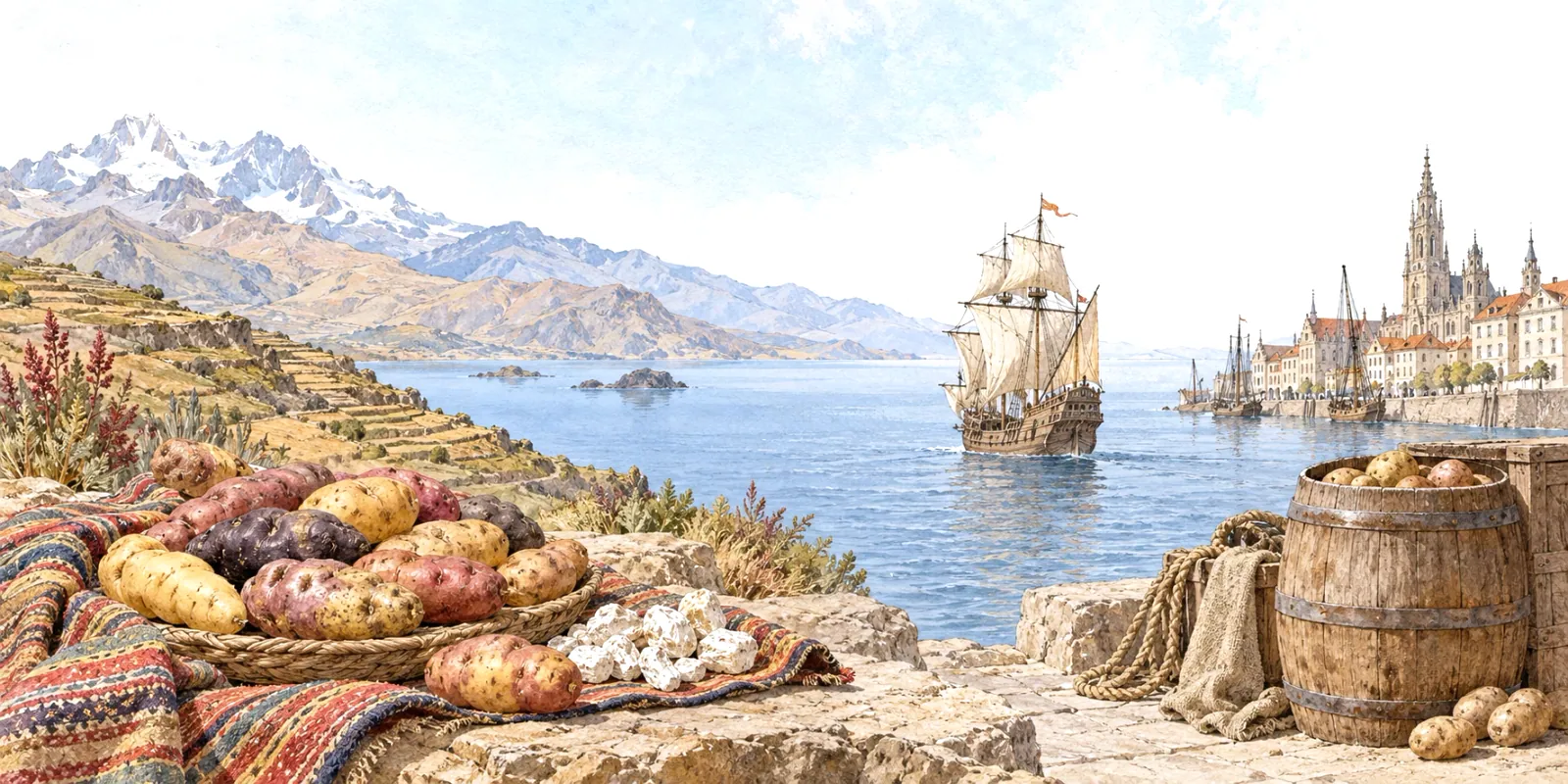
Barrels of potatoes were shipped from Gran Canaria to Antwerp in November 1567 — among the earliest documented potatoes in mainland Europe.
→ From the Andes to Europe - Prevailing view
Cultivated potatoes trace back to a single domestication in southern Peru (Spooner et al. 2005); the International Potato Center locates it near Lake Titicaca.
→ From the Andes to Europe - Documented
Tea leaves found in the tomb complex of the Western Han emperor Jing (d. 141 BCE) are the oldest physical evidence of tea yet identified.
→ Tea: from the hills of southern China to the world's cup - Disputed
When and exactly where tea was first domesticated is unsettled; the main genetic study proposes southern China and gives both 'over 3,000' and 'over 4,000' years ago.
→ Tea: from the hills of southern China to the world's cup - Local tradition
Tea is said to have first reached Tibet in the dowry of the Tang princess Wencheng; archaeological tea from western Tibet is several centuries older.
→ Tea: from the hills of southern China to the world's cup - Local tradition
The story of the goatherd Kaldi and his dancing goats is a legend with no documentary basis.
→ Coffee: from Ethiopian forests to the world's cafés - Prevailing view
Coffee drinking is first documented among religious mystics in Yemen in the mid-fifteenth century.
→ Coffee: from Ethiopian forests to the world's cafés - Disputed
Gabriel de Clieu's coffee plant reached Martinique in 1720 or 1723; the date is disputed.
→ Coffee: from Ethiopian forests to the world's cafés - Disputed
Joseph Talon's first truffle oaks at Saint-Saturnin-lès-Apt are usually dated to 1808; some accounts give 1810-1815.
→ Mushrooms and truffles: from the forest floor to the farm - Disputed
That Claudius was killed by a death cap is a modern inference; the Roman sources say poison was added to a mushroom dish, and Suetonius records that even this was disputed.
→ Mushrooms and truffles: from the forest floor to the farm - Documented
A. B. Frank coined the term mycorrhiza in 1885 from his study of truffle roots.
→ Mushrooms and truffles: from the forest floor to the farm - Documented
A shell fishhook from Sakitari Cave, Okinawa, dated to about 23,000 years ago, is the oldest fishhook yet reported.
→ Fish and seafood: hooks, salt, steam and farms - Disputed
Whether overfishing caused the late sixteenth-century collapse of the Øresund herring fishery is debated; ancient DNA shows harm to the stock but no early shift in Baltic herring populations.
→ Fish and seafood: hooks, salt, steam and farms - Documented
In 2022 aquaculture produced 51 % of the world's aquatic animals, overtaking capture fisheries for the first time.
→ Fish and seafood: hooks, salt, steam and farms - Prevailing view
All maize descends from a single domestication of Balsas teosinte in southern Mexico about 9,000 years ago.
→ Cereals: the grasses that fed the world - Disputed
Whether maize was first domesticated in the Mexican highlands or in the lowland Balsas valley is debated: molecular data point to the highlands, the oldest archaeological maize to the lowlands.
→ Cereals: the grasses that fed the world - Disputed
Wheat and barley domestication in the Fertile Crescent was a protracted process lasting up to 2,000 years; some scholars argue it was faster.
→ Cereals: the grasses that fed the world - Prevailing view
Rye began as a weed of wheat and barley fields and was probably domesticated in western Europe only about 2,500 to 2,000 years ago.
→ Cereals: the grasses that fed the world - Documented
Pulses, in FAO's definition, are legumes harvested only for their dry seed; soybeans and groundnuts are legumes but are classed as oil crops, not pulses.
→ Legumes: lentils, beans and the plants that feed the soil - Disputed
Where and how many times soybean was domesticated is unresolved; archaeological seeds suggest a long association with people in northern China, Korea and Japan.
→ Legumes: lentils, beans and the plants that feed the soil - Prevailing view
Pea was domesticated twice, independently: the common pea and the Abyssinian pea.
→ Legumes: lentils, beans and the plants that feed the soil - Documented
Legumes obtain nitrogen from the air through rhizobia bacteria in their root nodules, as shown by Hellriegel and Wilfarth (1886) and Beijerinck (1888).
→ Legumes: lentils, beans and the plants that feed the soil - Disputed
Sweet potato reached Polynesia before Europeans; whether people carried it from South America or seeds dispersed naturally is debated, though most scholars favour human transfer.
→ Roots and tubers: cassava, sweet potato, yam, taro and the Andean crops - Prevailing view
Cassava was introduced to the African coast in the sixteenth century, before 1600, by Portuguese traders and the slave trade.
→ Roots and tubers: cassava, sweet potato, yam, taro and the Andean crops - Documented
Agriculture arose independently in the highlands of New Guinea, with mound cultivation at Kuk by 6,950 to 6,440 years ago.
→ Roots and tubers: cassava, sweet potato, yam, taro and the Andean crops - Prevailing view
Sheep, goats, pigs and taurine cattle were domesticated in the Fertile Crescent between about 11,000 and 10,000 years ago (calibrated).
→ Meat and butchery: from the first herds to the packing house - Prevailing view
The first unambiguous domestic chickens date to about 1650-1250 BCE in central Thailand; earlier claims from China, India and Europe have not held up.
→ Meat and butchery: from the first herds to the packing house - Local tradition
The Worshipful Company of Butchers had slaughterhouses and a hall in London in 975.
→ Meat and butchery: from the first herds to the packing house - Documented
Chicago's Union Stock Yard opened on Christmas Day 1865.
→ Meat and butchery: from the first herds to the packing house - Documented
Vavilov's centres of origin (1926) are a historical model, and Vavilov himself kept revising them until 1940. Modern studies test crop origins with genetics, archaeology and linguistics.
→ Vegetables: from wild cabbage to the Brussels chicon - Prevailing view
Cultivated Brassica oleracea was first grown in the eastern Mediterranean, and its closest living wild relative is the Aegean Brassica cretica. Older studies proposed other wild ancestors.
→ Vegetables: from wild cabbage to the Brussels chicon - Disputed
Witloof was developed in Brussels in the mid-nineteenth century. The attribution to the gardener François Bréziers, around 1840, is called the most plausible account, but a story of an accidental discovery by a Schaerbeek or Evere farmer persists.
→ Vegetables: from wild cabbage to the Brussels chicon - Prevailing view
The cultivated tomato was domesticated in two stages: a semi-domesticated form arose in South America, and the cultivated tomato was selected again in Mexico.
→ Vegetables: from wild cabbage to the Brussels chicon - Prevailing view
The domesticated apple descends mainly from Malus sieversii of the Tian Shan, but modern apples are genetically closer to the European crabapple, which crossed in as the apple moved west.
→ Fruit: from the apple forests of the Tian Shan to the banana boat - Prevailing view
Citrus originated in the south-east foothills of the Himalayas, in eastern Assam, northern Myanmar and western Yunnan, and diversified 6 to 8 million years ago.
→ Fruit: from the apple forests of the Tian Shan to the banana boat - Prevailing view
Grapevines were domesticated twice at about the same time, some 11,000 years ago, in Western Asia and in the Caucasus.
→ Fruit: from the apple forests of the Tian Shan to the banana boat - Disputed
Van Mons's claims about raising new pear varieties from seed were questioned in the 1850s by Decaisne, and Darwin noted that Van Mons had been careless in labelling the varieties he sowed.
→ Fruit: from the apple forests of the Tian Shan to the banana boat - Documented
Fusarium wilt race 1 made Gros Michel uneconomic by the mid-twentieth century, and it was replaced by Cavendish, now more than 99 % of exported bananas.
→ Fruit: from the apple forests of the Tian Shan to the banana boat - Documented
A fermented drink of rice, honey and fruit was made at Jiahu, China, as early as the seventh millennium BC.
→ Other drinks: mead, cider, rice wine, palm wine, cacao and spa water - Local tradition
The Domfront perry specification states that the perry pear predates the cider-apple varieties brought to Normandy from north-west Spain in the eleventh century.
→ Other drinks: mead, cider, rice wine, palm wine, cacao and spa water - Local tradition
Rice-wine brewing reached Japan from Korea in the third century, according to the Kojiki.
→ Other drinks: mead, cider, rice wine, palm wine, cacao and spa water - Local tradition
Kombucha originated in north-eastern China around 220 BC, according to Chinese folkloric sources.
→ Other drinks: mead, cider, rice wine, palm wine, cacao and spa water - Prevailing view
Cacao was first domesticated in the upper Amazon, not Mesoamerica: the earliest known use, about 5,300 years ago, is in south-east Ecuador.
→ Other drinks: mead, cider, rice wine, palm wine, cacao and spa water - Documented
Peppercorns from southern India were used in the mummification of Ramses II in 1213 BCE.
→ Spices and salt: pepper, nutmeg and the taxed necessity - Disputed
A clove reported from Terqa, Syria, dated to about 1700 BCE, would be the earliest clove outside the Moluccas, but the identification is controversial.
→ Spices and salt: pepper, nutmeg and the taxed necessity - Documented
During and after the VOC conquest of the Banda Islands, completed under Jan Pieterszoon Coen in 1621, an estimated 90 % of the islands' original population died. About 800 were deported to Batavia, and the VOC brought in enslaved people to work the nutmeg plantations.
→ Spices and salt: pepper, nutmeg and the taxed necessity - Documented
France's gabelle was abolished on 1 December 1790, reinstated in 1806 and ended for good by the finance law of 31 December 1945.
→ Spices and salt: pepper, nutmeg and the taxed necessity - Documented
Dried pasta was documented in Sicily in 1154, more than a century before Marco Polo returned to Venice in 1295.
→ Did Marco Polo bring pasta to Italy? - Prevailing view
The spread of the Marco Polo legend is commonly traced to a 1929 article in The New Macaroni Journal, the trade magazine of the US macaroni manufacturers' association.
→ Did Marco Polo bring pasta to Italy? - Documented
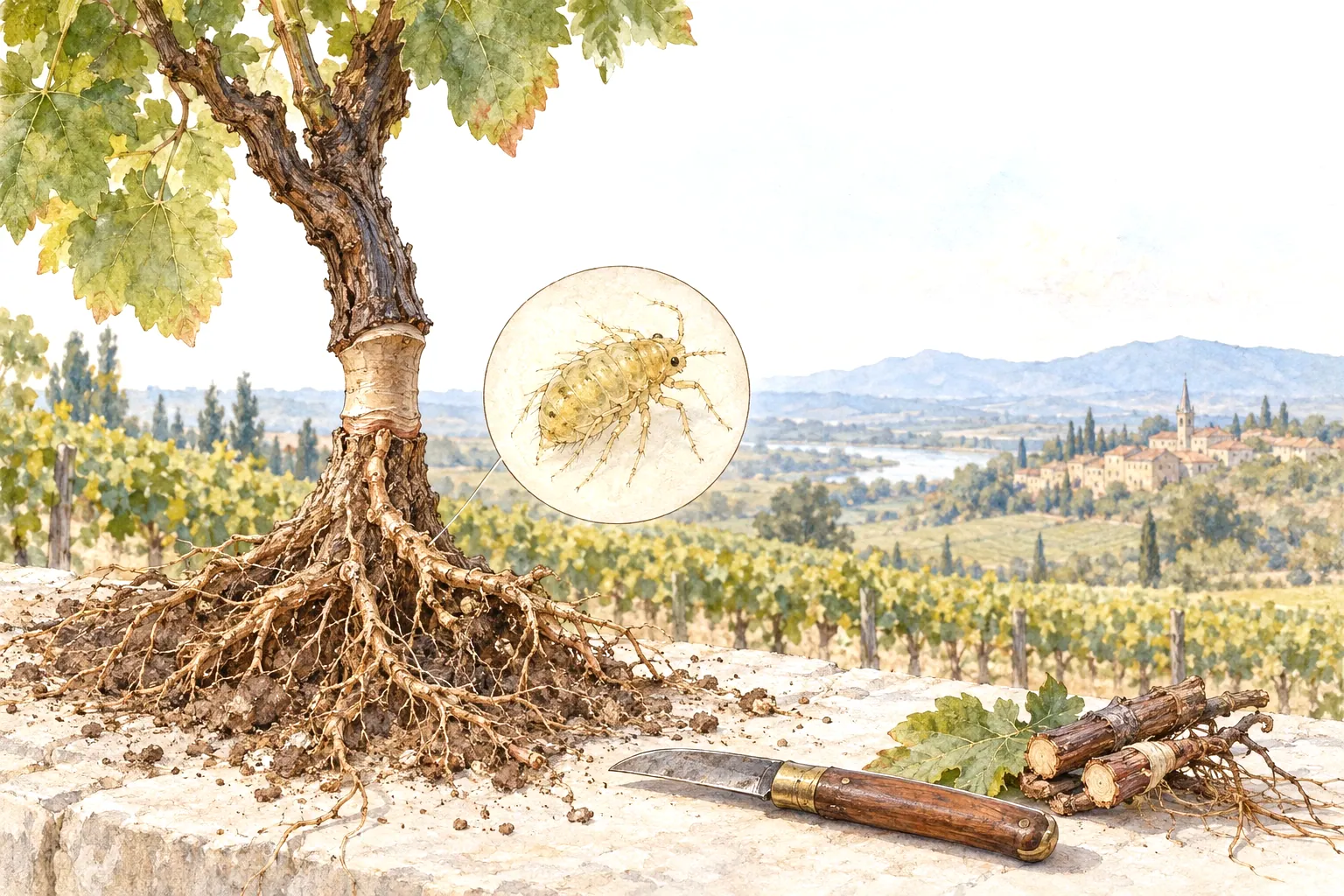
The first vine deaths linked to phylloxera were recorded in 1863; the insect was identified on roots at the Château de Lagoy on 15 July 1868.
→ Phylloxera: the insect that remade the vineyards of the world - Prevailing view
Population genetics points to the upper Mississippi River basin, where phylloxera feeds on Vitis riparia, as the source of the European invasion.
→ Phylloxera: the insect that remade the vineyards of the world - Documented
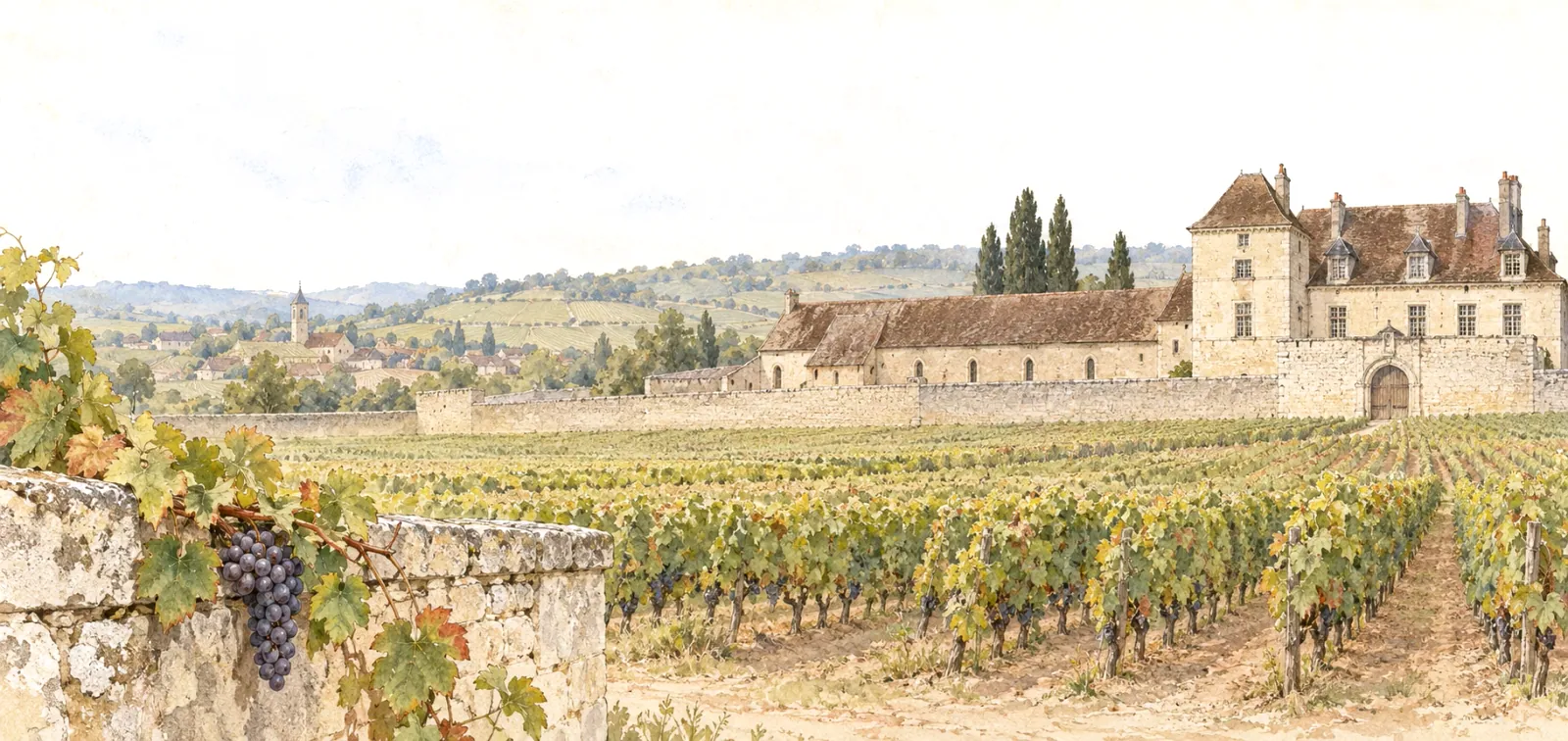
The cellier, the oldest building at the Clos de Vougeot, was built by the monks of Cîteaux between about 1160 and 1170.
→ The Cistercians and the Clos de Vougeot - Local tradition
Twentieth-century claims that the Clos's vines descend directly from vines planted by the monks are a modern legend, not a documented fact.
→ The Cistercians and the Clos de Vougeot - Documented
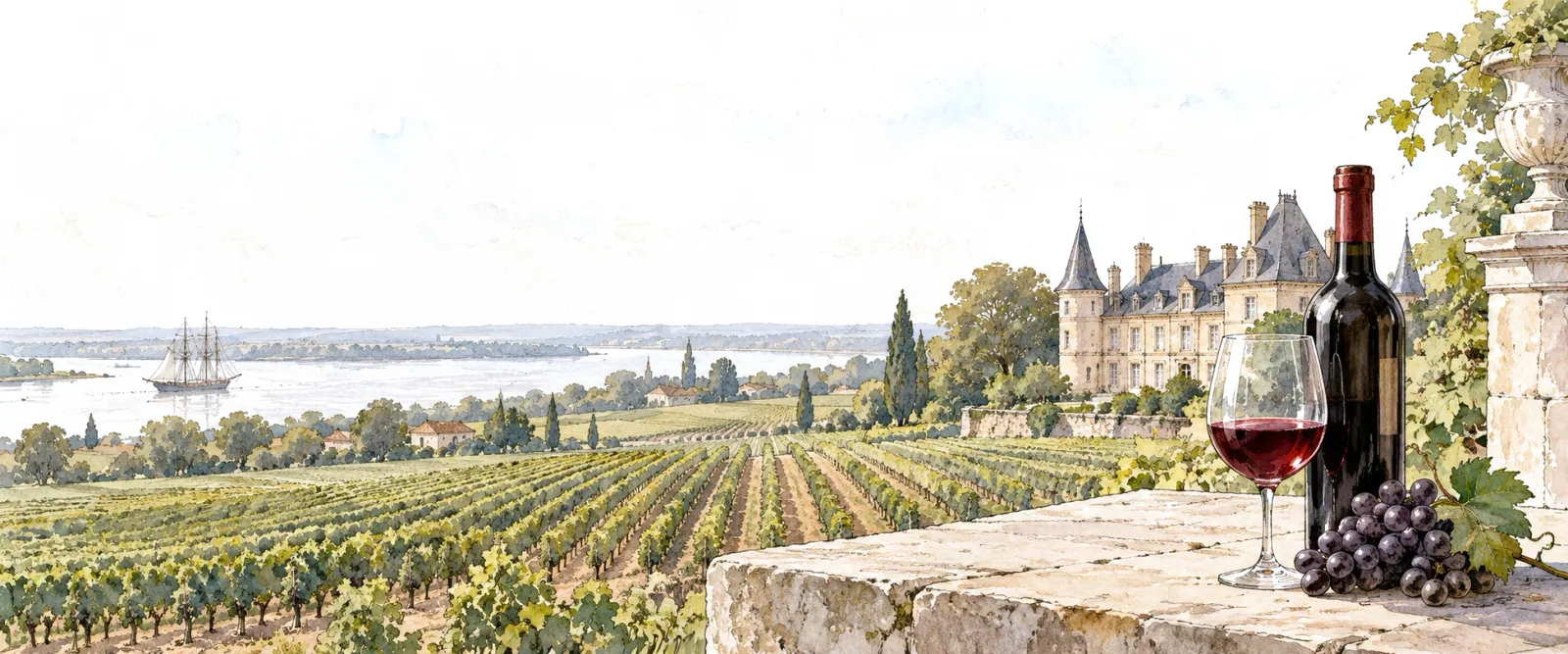
The Bordeaux brokers' list is dated 18 April 1855, thirteen days after the Chamber of Commerce asked for it on 5 April.
→ The 1855 Bordeaux classification - Documented
Since 1855 the list has officially changed twice: Cantemerle was added in September 1855 and Mouton Rothschild was promoted in June 1973.
→ The 1855 Bordeaux classification - Documented
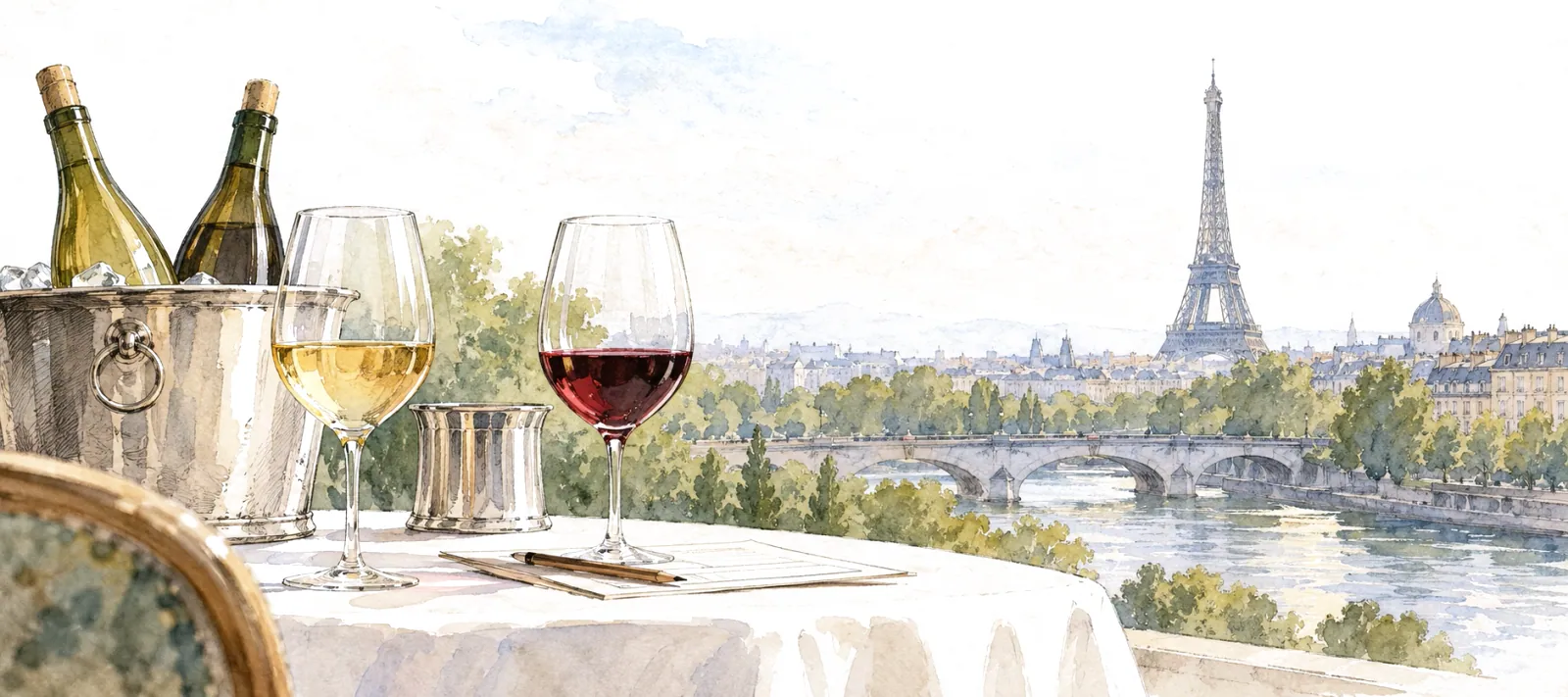
At the Paris tasting of 24 May 1976 the 1973 Chateau Montelena Chardonnay and the 1973 Stag's Leap Wine Cellars Cabernet Sauvignon, both from Napa, placed first in their flights.
→ The Judgment of Paris, 1976 - Disputed
Whether the scores of the organisers Steven Spurrier and Patricia Gallagher counted in the 1976 result is reported differently: Time described nine French judges, while Ashenfelter and Quandt list eleven tasters and say all were counted.
→ The Judgment of Paris, 1976 - Documented
Christopher Merret's paper describing wine-coopers adding sugar and molasses to make wines 'brisk and sparkling' was read to the Royal Society on 17 December 1662.
→ Did Dom Pérignon invent Champagne? - Local tradition
That Dom Pérignon invented sparkling Champagne is a legend, spread by the Champagne merchants' pamphlet for the 1889 Paris exhibition; the 'drinking stars' line is only attributed to him.
→ Did Dom Pérignon invent Champagne? - Documented
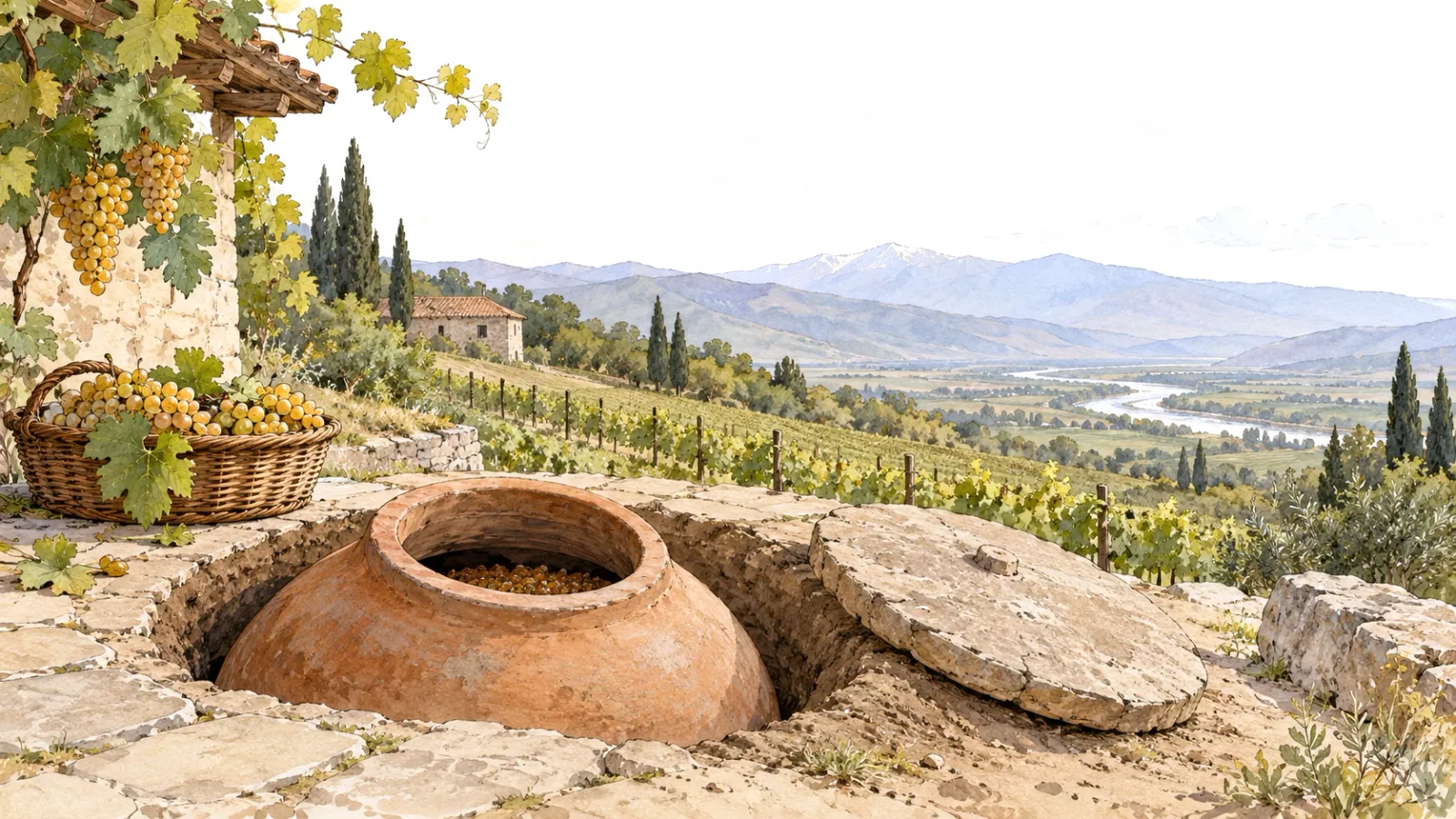
The ancient Georgian traditional qvevri wine-making method was inscribed on UNESCO's Representative List of the Intangible Cultural Heritage of Humanity in 2013.
→ Georgia's qvevri - Prevailing view
Chemical residues in pottery from Shulaveris Gora and Gadachrili Gora show grape wine being made in Georgia around 6000–5800 BC; whether those jars were buried like qvevri is unknown.
→ Georgia's qvevri - Documented
The Exchequer Rolls for 1494-5 record a payment to Friar John Cor of eight bolls of malt for making aqua vitae. It is an early Scottish record, not proof that whisky was invented there or then.
→ A history of whisky - Documented
The Annals of Connacht record under 1405 the death of Risderd Mag Ragnaill after drinking 'water of life' to excess.
→ A history of whisky - Local tradition
Distilling in Ireland began in the 6th century with monks.
→ A history of whisky - Documented
Single Malt Scotch Whisky must, by law, be distilled in pot stills.
→ Pot still distillation - Documented
Coffey patented his continuous still in 1830; Robert Stein's column still came two years earlier.
→ Column still (Coffey still) - Documented
Scotch Whisky must mature for at least three years in oak casks of no more than 700 litres, in Scotland.
→ Cask maturation - Documented
"Islands" is not one of the five protected regional or local names in the Scotch Whisky Regulations 2009.
→ Scotland - Documented
The Irish whiskey geographical indication covers the whole island, including Northern Ireland.
→ Ireland - Documented
Bourbon does not have to be made in Kentucky; US rules require it to be distilled and aged in the United States.
→ Kentucky - Documented
Scotch Whisky must be bottled at not less than 40% alcohol by volume.
→ Scotch Whisky - Documented
Irish whiskey must be matured for at least three years on the island of Ireland.
→ Irish whiskey - Local tradition
Distilling in Ireland began with monks in the 6th century.
→ Irish whiskey - Documented
Bourbon must be made from a mash of at least 51% corn and stored in charred new oak barrels.
→ Bourbon whiskey - Documented
The 1494-5 entry records eight bolls of malt given to Friar John Cor for making aqua vitae.
→ Friar John Cor's malt, Exchequer Rolls 1494-5 - Disputed
The aqua vitae of the 1494-5 entry was made at Lindores Abbey.
→ Friar John Cor's malt, Exchequer Rolls 1494-5 - Documented
Coffey's patent dates from 1830; the three sources checked here agree on the year.
→ Coffey's continuous still patent - Disputed
The year of the Islington prosecution is not settled in the sources checked (Smith 2017 gives 1903); it is left undated here pending a primary source.
→ Royal Commission on Whiskey: "What is whisky?" - Documented
The legend that Syrah was brought from Shiraz in Persia is contradicted by DNA evidence placing its parents in south-eastern France.
→ Syrah - Documented
Cabernet Sauvignon is a cross of Cabernet Franc and Sauvignon Blanc, shown by DNA markers in 1997.
→ Cabernet Sauvignon - Prevailing view
The Chinon specification quotes Rabelais's *Gargantua* (1534), 'ce bon vin de breton', and takes it to mean Cabernet Franc wine.
→ Cabernet Franc - Documented
In 2015 Merlot covered 266,000 ha in 37 countries, about 3% of the world's vineyard area.
→ Merlot - Documented
Malbec almost doubled its area in Argentina between 2000 and 2015, to about 18% of the country's vineyard.
→ Malbec - Documented
Carmenère was identified in Chilean vineyards sold as Merlot by Jean-Michel Boursiquot in November 1994.
→ Carmenère - Disputed
Its exact parentage is unsettled: Gros Cabernet × Cabernet Franc has been proposed, but VIVC lists different propositions.
→ Carmenère - Documented
The name 'Madiran' for the red wines is first cited in 1744, according to the appellation file.
→ Tannat - Prevailing view
The Roman *vitis allobrogica* mentioned by Pliny may have been close to Mondeuse; the Savoie appellation file says 'probably', and no DNA evidence links them.
→ Mondeuse Noire - Documented
Aramon's French area fell by more than 99% in sixty years, from 150,230 ha in 1958 to 1,141 ha in 2018.
→ Aramon - Documented
In 1395 Duke Philip the Bold of Burgundy banned Gamay in favour of Pinot, and Gamay was pulled up in the Côte d'Or — one of the earliest quality regulations in wine.
→ Pinot Noir - Documented
The grapevine was the first fruit crop to have its genome sequenced (2007), using a line derived from Pinot Noir.
→ Pinot Noir - Prevailing view
The name probably refers to the pine-cone shape of the bunch; the link is widely accepted but not documented at the name's origin.
→ Pinot Noir - Documented
24 of Burgundy's 33 Grand Cru appellations lie in the narrow Côte de Nuits, a strip only a few hundred metres wide in places.
→ Burgundy - Documented
Pinot and the humble Gouais Blanc are the parents of Chardonnay, Aligoté and Gamay — so three of Burgundy's four main grapes are full siblings, and the fourth is their parent.
→ Burgundy - Documented
The Hospices de Beaune charity auction, held since 1859, is in the Hospices' own words the most famous charity sale in the world.
→ Burgundy - Documented
The Clos de Vougeot's château has been the seat of the Confrérie des Chevaliers du Tastevin since 1944; the brotherhood was founded in Nuits-Saint-Georges in 1934, during the export crisis caused by American Prohibition.
→ Côte de Nuits - Documented
Romanée-Conti covers just 1.81 hectares, yet it is among the most famous vineyards on earth.
→ Côte de Nuits - Documented
Merlot, now two-thirds of Bordeaux's red vineyard, only began to spread in the region from about 1830. At the end of the eighteenth century the Cabernets, Côt and Petit Verdot were the main varieties.
→ Bordeaux - Local tradition
The appellation rules repeat a local tradition that the Bituriges Vivisques planted a cold-hardy vine, "Vitis biturica", said to be the ancestor of the Cabernets. The rules give no evidence for the link, so it is recorded here as tradition.
→ Bordeaux - Documented
In their 2025 version, the Haut-Médoc rules admit only wines from producers who are certified organic or who hold an approved environmental certification.
→ Haut-Médoc - Documented
Thomas Jefferson's ranking of 1787 already placed Latour and Lafite among the first growths, 68 years before the 1855 classification.
→ Pauillac - Local tradition
The name Beychevelle is said to recall ships lowering their sails in salute to the Baron de Beychevelle. This is a local tradition; the Bordeaux wine council suggests the manoeuvre was more likely a way to enter port against headwinds.
→ Saint-Julien - Documented
Château Haut-Brion appears in both the 1855 classification, as a first growth, and the 1959 Graves classification.
→ Pessac-Léognan - Documented
Château d'Yquem is the only estate ranked Premier Cru Supérieur in the 1855 classification.
→ Sauternes - Documented
Stories that noble-rot harvesting began by accident in 1836 or 1847, when picking was delayed, are legends. An official report of 1741 already describes late, repeated picking of almost rotten grapes.
→ Sauternes - Documented
The Saint-Émilion classification is meant to be revised about every ten years. The 2022 list replaced one from 2012 that had 18 Premiers Grands Crus Classés and 64 Grands Crus Classés.
→ Saint-Émilion - Documented
Piedmont has 19 DOCG wines, more than any other region of Italy in the Ministry's list (Veneto has 13, plus Lison shared with Friuli).
→ Piedmont - Documented
Barolo and Barbaresco were among the first Italian DOCs, both approved by presidential decree on 23 April 1966, and both became DOCG in 1980.
→ Barolo - Local tradition
The name Barbaresco is said to come from the barbarians who invaded the Roman Empire, or from a Gaulish wine called Barbaritium; neither story is documented.
→ Barbaresco - Documented
A Franciacorta Riserva must spend at least five years (60 months) on its lees before disgorging.
→ Franciacorta - Documented
The first commercial bottle of Amarone della Valpolicella was sold in 1953; the wine became a separate DOCG only in 2010.
→ Valpolicella - Local tradition
The name Valpolicella is said to come from Latin 'Polesella' (land of many fruits) or 'vallis-polis-cellae' (valley of many cellars); the production rules give both as hypotheses.
→ Valpolicella - Documented
Conegliano's school of viticulture and oenology, founded in 1876, was the first in Italy.
→ Conegliano Valdobbiadene - Documented
Trento DOC, recognised on 9 July 1993, was the first Italian denomination reserved only for sparkling wine made by second fermentation in bottle.
→ Trento