
Explore the world · Ingredient history · Reference page
Fruit: from the apple forests of the Tian Shan to the banana boat
The sweet apple began in the wild fruit forests of the Tian Shan, citrus in the foothills of the eastern Himalayas, and the banana in New Guinea. Belgian pear breeders and nineteenth-century pomologists multiplied varieties. Steamships and refrigeration then turned bananas and other perishable fruit into world commodities.
Apples from the Tian Shan
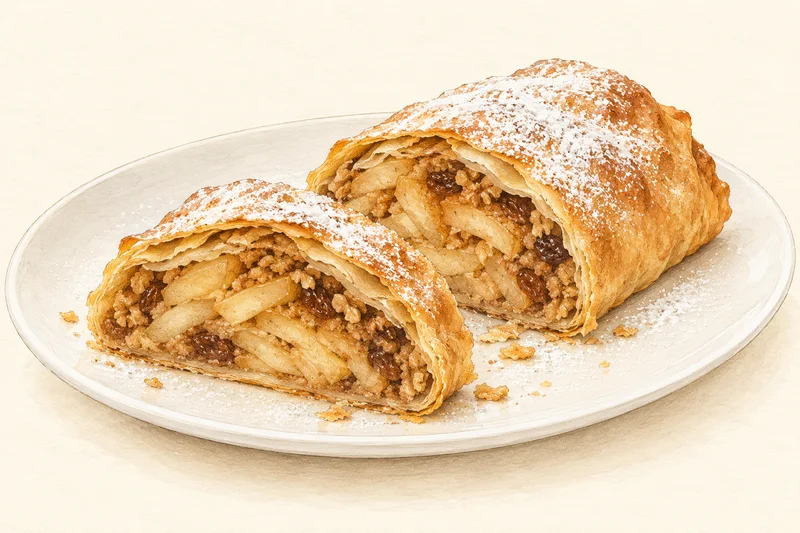
The wild ancestor of the eating apple is Malus sieversii, which grows in fruit forests on the slopes of the Tian Shan in Central Asia. In the early twentieth century Nikolai Vavilov travelled through the region and reported the greatest apple diversity near Almaty in south-east Kazakhstan, formerly Alma-Ata, a name the review glosses as "father of apples". He found that these wild fruits looked more like cultivated apples than any other crabapples he had seen, and he concluded that this was the apple's homeland.
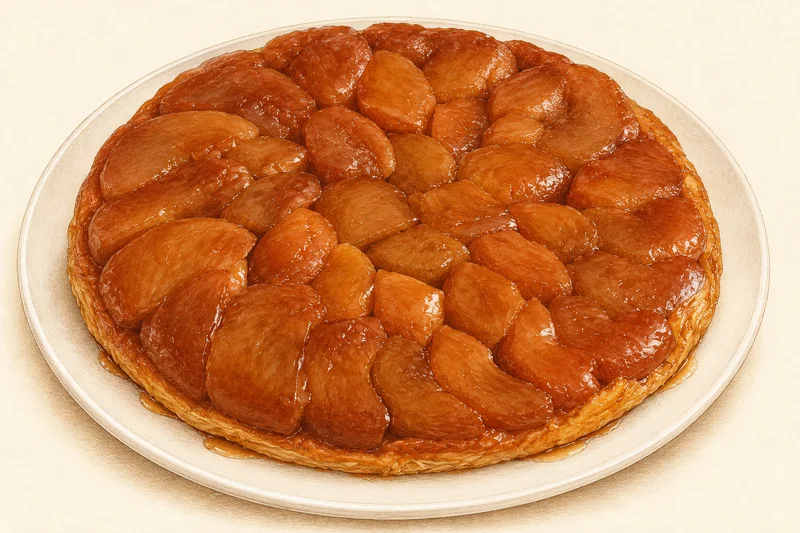
Genetics has confirmed and complicated that picture. In 2012 Cornille and colleagues analysed 839 trees from China to Spain. They confirmed M. sieversii as the main progenitor and the Tian Shan as the likely first area of domestication. They also found that the European crabapple, M. sylvestris, had crossed into apples as they moved west along the Silk Road. Modern apples are now genetically closer to that crabapple than to their Central Asian ancestor. A form like the modern apple appears in the Near East around 4,000 years ago, and Greeks and Romans carried it into Europe and North Africa.
The wild forests are now under threat. A 2025 review classes M. sieversii as vulnerable. It cites an estimate that the forest has shrunk to 7 % of the area recorded in 1930, with 70 % of the loss in the last 30 years.
Citrus from the eastern Himalayas
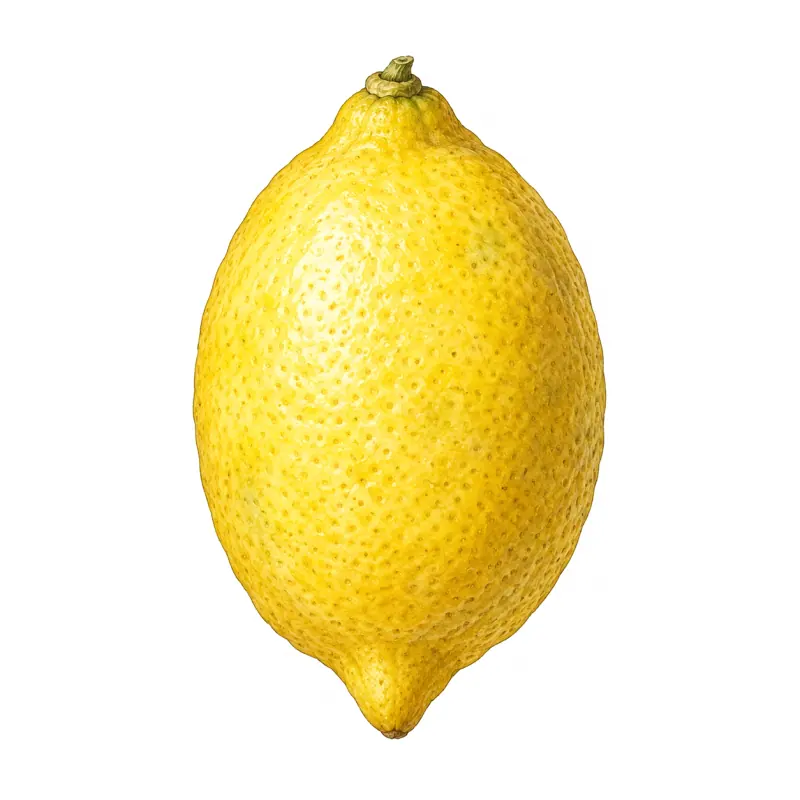
Oranges, lemons and mandarins come from a small number of wild species that have crossed with each other many times. In 2018 Wu and colleagues compared the genomes of 60 citrus accessions and described ten natural species. They proposed that citrus began in the south-east foothills of the Himalayas, in a region taking in eastern Assam, northern Myanmar and western Yunnan.
The dates are geological, not human. A fossil leaf from Lincang in Yunnan, Citrus linczangensis, shows that a common citrus ancestor lived there about 8 million years ago. The genomes point to a rapid burst of new species 6 to 8 million years ago, when the monsoons weakened and the climate dried. A later branch crossed into Australia about 4 million years ago and gave rise to the Australian limes.
The fruit in today's shops are hybrids. The study found that mandarins and the sweet orange are closely interrelated and that most mandarins carry some pummelo ancestry, and the amount of pummelo tracks fruit size and acidity. The authors suggest that pummelo genes helped growers select palatable mandarins. One ancient Chinese mandarin is probably the fruit described in a monograph on citrus by Han Yen-Chih in AD 1178.
Grapes: table fruit and wine
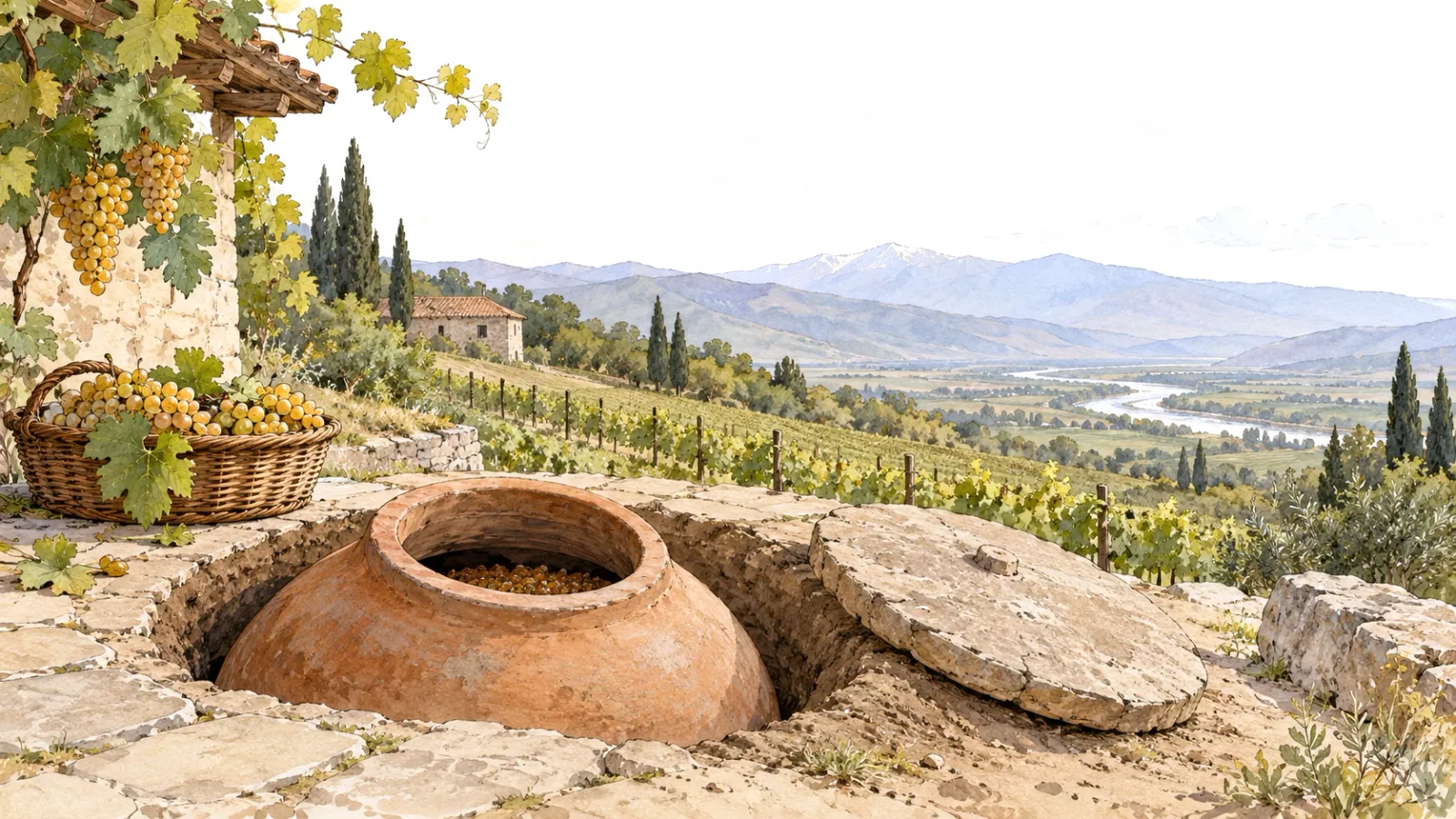
The grape is a fruit before it is a wine. A genome study of 3,525 wild and cultivated vines, published by Dong and colleagues in 2023, concludes that grapevines were domesticated twice, at about the same time, some 11,000 years ago. One domestication took place in Western Asia and one in the Caucasus, and between them they produced both table and wine grapes. Vines from Western Asia moved into Europe with early farmers and crossed with wild European grapes.
The Caucasus link runs through the wine pages of this atlas, where Georgia's qvevri covers early wine in that country. Grapes now rank among the world's five most produced fruits.
Bananas and plantains from New Guinea
Wild bananas are full of hard seeds. Edible bananas arose when hybrids between wild forms became sterile and people selected plants whose fruit swelled without seeds. Because they have no seeds, they must be grown from cuttings, and some varieties have been cloned for thousands of years. Perrier and colleagues brought genetics, archaeology and linguistics together to trace this history. Phytoliths at Kuk Swamp in the New Guinea highlands show bananas under cultivation between 6,950 and 6,440 years ago. New Guinea is the home of the wild subspecies that contributed to many cultivated groups.
People then carried bananas across the tropics. Plantains reached Africa early. Phytoliths at Nkang in Cameroon date to between 2,750 and 2,100 years ago, and the Proto-Bantu word for plantain suggests an arrival before about 3,000 years ago. How they crossed the Indian Ocean is not known. Bananas also reached the eastern Mediterranean surprisingly early: dental calculus from people buried at Megiddo in the second millennium BCE shows a probable banana. Bananas, including plantains, are now one of the world's five most produced fruits, and FAO counts more than 1,000 varieties.
Pomology and the Belgian pear breeders
Fruit trees such as apples do not come true from seed. Their seedlings are highly variable, so a good tree has to be multiplied by grafting. Cornille and colleagues think grafting was probably developed around 3,000 years ago, and it explains how famous varieties could be kept for centuries.
Between the sixteenth and nineteenth centuries Europe produced a flood of new pears, especially in France, Italy and Belgium. In Belgium Hardenpont (1705-1774) was the first in a long line of breeders. The best known is Jean-Baptiste Van Mons (1765-1842), whom later writers called "an early apostle of selection". He raised new pears from seed and selected among the seedlings. His book Arbres fruitiers appeared in Louvain in 1835-36. Belgian names such as Triomphe de Jodoigne, Seigneur Esperen and Beurré Bosc are still kept in pear collections.
His claims were questioned in his own century. In 1855 Joseph Decaisne published a critical examination of "the doctrine of Van Mons". Charles Darwin, asking growers whether seedling pears resemble their parents, noted the same year that "it now appears that Van Mons was careless in marking the varieties sown".
Steamships, refrigeration and the global fruit trade
In Britain, refrigerated ships from the mid-1870s widened the supply of imported food "from meat and wheat to fruits and other exotica", and from the 1880s canned fruit was promoted to working-class households. Bananas, an uncommon curiosity in Europe and North America before the mid to late 1800s, were then moved in bulk by steamship from the mid to late 1800s. The favoured variety was Gros Michel. Its thick skin did not bruise easily, and it was shipped in bunches that ripened on the way.
The trade then ran into disease. Fusarium wilt, or Panama disease, was first recorded on Gros Michel in the Americas by the mid-1890s. It spread through the exporting countries until, by the mid-twentieth century, Gros Michel was no longer worth growing. It was replaced by the resistant Cavendish. Cavendish now makes up more than 99 % of exported bananas and close to half of all banana production. A new strain, tropical race 4, was first recorded in Taiwan in the 1990s. It kills Cavendish too, and has since spread to Australia, Asia, the Middle East, Africa and South America.
World banana trade is now around 20 million tonnes a year. More than 90 % of exports come from Central and South America and the Philippines. Apples have a similar problem with diversity: a handful of cultivars such as Golden Delicious, Cox's Orange Pippin and McIntosh dominate commercial production and are the main parents of new varieties.
How it connects
Story
Wine region
- related Georgia
Ingredient
- related Citrus peel (orange and lemon)
Recipe
- related Tarte Tatin
- related Wiener Apfelstrudel
Continue exploring
- CountryKazakhstan1 entry in the atlas so far
- StoryGeorgia's qvevriGadachrili Gora (Kvemo Kartli), Georgia
 RecipeWiener ApfelstrudelVienna, Austria
- RecipeTarte TatinLamotte-Beuvron, France
- StoryOther drinks: mead, cider, rice wine, palm wine, cacao and spa waterPeople's Republic of China
- StoryVegetables: from wild cabbage to the Brussels chiconGreece
- IngredientCitrus peel (orange and lemon)Citrus × sinensis, Citrus × limon and related citrus (peel)
- Wine regionGeorgiaGeorgia (national overview), Georgia
- StoryA history of beer
 StoryFrom the Andes to EuropeLake Titicaca, Peru